

If you want a haircut that combines sharp faded sides with longer hair at the back, the Burst Fade Mullet is one of the most distinctive choices to consider in 2026. It brings together the curved shape of a burst fade and the longer, flowing back of a modern mullet.
The style can be adapted to straight, wavy, curly, coily, thick, or fine hair. You can also choose between a subtle low burst fade, a stronger mid fade, or a bold high or skin fade. The length and texture on top and at the back can completely change the final appearance.
Whether you want a messy everyday haircut, a curly mullet, a textured finish, or a cleaner modern look, there are plenty of ways to wear this haircut. Here are 25 Burst Fade Mullet styles for men, followed by tips for choosing, styling, and maintaining the right version for your hair.
What Is a Burst Fade Mullet?
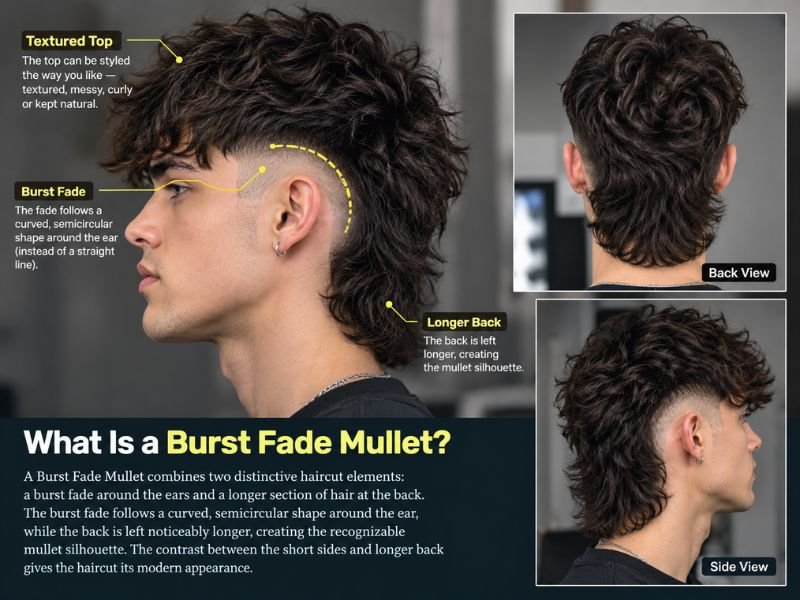
A Burst Fade Mullet combines two distinctive haircut elements: a burst fade around the ears and a longer section of hair at the back.
Instead of fading evenly around the entire side of the head, the burst fade follows a curved, semicircular shape around the ear. The back is then left noticeably longer, creating the recognizable mullet silhouette.
The contrast between the short sides and longer back gives the haircut its modern appearance. The top can be kept short, textured, curly, messy, or relatively long depending on the look you want.Unlike a traditional mullet, the burst fade creates a cleaner transition around the ears and gives the haircut a sharper outline.
25 Best Burst Fade Mullet Styles for Men:
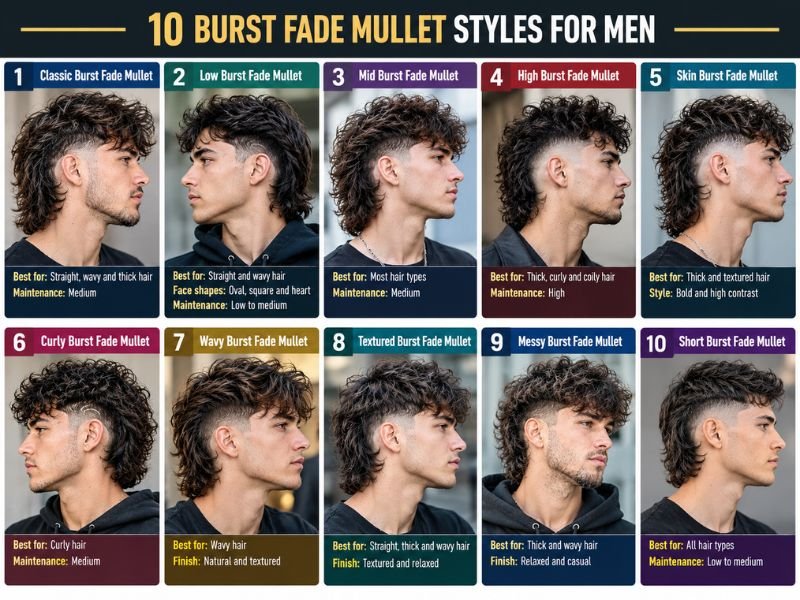
1. Classic Burst Fade Mullet
The classic Burst Fade Mullet keeps the sides clean while leaving enough length at the back to create the traditional mullet shape.
The top can be lightly textured instead of heavily styled, making this a good option if you want the haircut to look modern without being too dramatic.Ask your barber for a rounded burst fade around the ears and gradual length toward the back.
Best for: Straight, wavy, and thick hair
Maintenance: Medium
2. Low Burst Fade Mullet
A low burst fade gives the haircut a more subtle appearance. The fade stays lower around the ears while the top and back retain more weight.
This is a good choice if you like the mullet shape but do not want an extremely aggressive fade.It can also be easier to wear in situations where a very high fade would look too bold.
Best for: Straight and wavy hair
Face shapes: Oval, square, and heart
Maintenance: Low to medium
3. Mid Burst Fade Mullet
The mid version creates more contrast between the top, sides, and back.
If you are comparing different mid-level fade styles, our mid drop fade guide can help you understand another option. This creates a balanced look that works well with textured or messy hair.It is one of the more versatile options because you can keep the back moderate or grow it longer for a stronger mullet effect.
Best for: Most hair types
Maintenance: Medium
4. High Burst Fade Mullet
A high burst fade mullet creates a much stronger contrast.
The sides are taken shorter and higher around the ear area while the top and back remain longer. This makes the mullet immediately noticeable.A high fade can work particularly well when the top has plenty of texture or volume.
Best for: Thick, curly, and coily hair
Maintenance: High
5. Skin Burst Fade Mullet
For maximum contrast, you can pair a mullet with a skin burst fade.The sides are faded down extremely short around the ears, making the longer hair at the back stand out.
Because the skin fade becomes visible as the hair grows, this version usually requires more frequent barber visits than a softer fade.
Best for: Thick and textured hair
Style: Bold and high contrast
6. Curly Burst Fade Mullet
Curly hair gives the mullet extra volume and natural movement.
The burst fade cleans up the area around the ears while the curls remain longer on top and at the back. The result is a textured haircut that does not require the hair to be completely straightened.For curly hair, your barber should account for shrinkage when deciding how much length to leave.
Best for: Curly hair
Maintenance: Medium
A similar approach can also be seen in other modern curly hairstyles, such as our Curly Undercut.
7. Wavy Burst Fade Mullet
Natural waves work particularly well with the flowing shape of a mullet.
The waves add movement to the top and back while the burst fade keeps the area around the ears neat.Use a lightweight curl cream or texturizing product to enhance the natural pattern without making the hair heavy.
Best for: Wavy hair
Finish: Natural and textured
8. Textured Burst Fade Mullet
A textured version uses layers and uneven separation to create a more relaxed appearance.
Instead of making every section perfectly smooth, the top is styled with visible texture while the back maintains its length.A small amount of matte clay or texturizing product can help separate the layers.
Best for: Straight, thick, and wavy hair
9. Messy Burst Fade Mullet
The messy version is designed to look effortless rather than perfectly controlled.
Keep enough length on top and at the back to create movement. Then use your fingers to style the hair instead of using a comb for a perfectly polished finish.This works particularly well with naturally thick or wavy hair.
Best for: Thick and wavy hair
Finish: Relaxed and casual
10. Short Burst Fade Mullet
You do not need extremely long hair to wear a mullet.
A short Burst Fade Mullet keeps the back noticeably longer than the sides but avoids excessive length. This makes it easier to maintain and suitable for someone trying a mullet for the first time.
It is also a good starting point if you are growing your hair from a shorter haircut.
11. Long Burst Fade Mullet
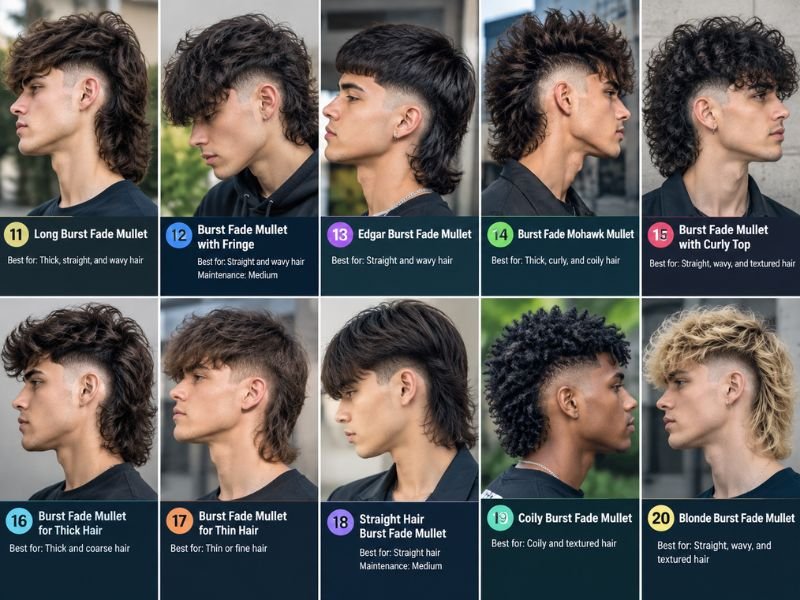
A long version puts more emphasis on the back.The hair can extend toward or beyond the collar while the sides remain sharply faded around the ears.
The longer the back becomes, the more obvious the mullet shape will be, so discuss the desired length with your barber before the cut.
Best for: Thick, straight, and wavy hair
12. Burst Fade Mullet with Fringe
Adding a fringe changes the shape of the front while keeping the longer mullet section at the back.
A textured fringe can soften the forehead and give the haircut a more youthful appearance.You can keep the fringe short and choppy or slightly longer for a softer look.
Best for: Straight and wavy hair
Maintenance: Medium
13. Edgar Burst Fade Mullet
The Edgar and mullet combination creates a sharper, more structured style.
The front can feature a straight or slightly textured fringe, while the sides transition into the burst fade and the back remains longer.This works especially well if you prefer defined lines rather than a loose, flowing haircut.
For more variations of this style, check out our guide to the Edgar Cut.
14. Burst Fade Mohawk Mullet
The Mohawk Mullet combines a central strip of longer hair with a burst fade around the sides.
The back remains longer, connecting the mohawk-inspired top to the mullet shape.This is one of the more dramatic versions and works best if you want a haircut that immediately stands out.
Best for: Thick, curly, and coily hair
15. Burst Fade Mullet with Curly Top
Instead of keeping the entire top uniform, you can emphasize the curls on top while allowing the back to remain longer.
The burst fade creates space around the ears, making the curls appear fuller by comparison.Use a curl cream on damp hair and avoid heavy products that flatten the curls.
16. Burst Fade Mullet for Thick Hair
Thick hair gives you plenty of volume for a strong mullet silhouette.
However, too much weight can make the haircut difficult to control. Ask your barber to remove some bulk from the top while preserving the length needed at the back.Texturizing can make thick hair easier to style without destroying the overall shape.
Best for: Thick and coarse hair
17. Burst Fade Mullet for Thin Hair
A Burst Fade Mullet can also be adapted for thinner hair.Keeping the sides short creates contrast with the longer top and back, which can make the remaining hair appear more noticeable.
Avoid extremely long, heavy layers because they can make fine hair appear flatter.A lightweight volumizing product can help add lift.
18. Straight Hair Burst Fade Mullet
Straight hair gives you a clean outline and makes the contrast between the fade and longer back easy to see.
You can wear the top forward, messy, parted, or brushed backward.For a sharper finish, use a lightweight styling clay or wax rather than applying too much product.
Best for: Straight hair
Maintenance: Medium
19. Coily Burst Fade Mullet
Coily hair creates a strong texture contrast against the faded sides.
Keep enough length at the top and back to show the natural pattern while using the burst fade to create a clean area around the ears.Because tightly coiled hair can shrink significantly, discuss the desired finished length with your barber before cutting.
20. Blonde Burst Fade Mullet
A blonde color can make the texture and layers of a Burst Fade Mullet more visible.
The faded sides provide contrast while the lighter top and back attract attention to the shape of the haircut.You can choose a natural blonde tone or a more noticeable color depending on your preference.
Best for: Straight, wavy, and textured hair
21. Burst Fade Mullet with Design
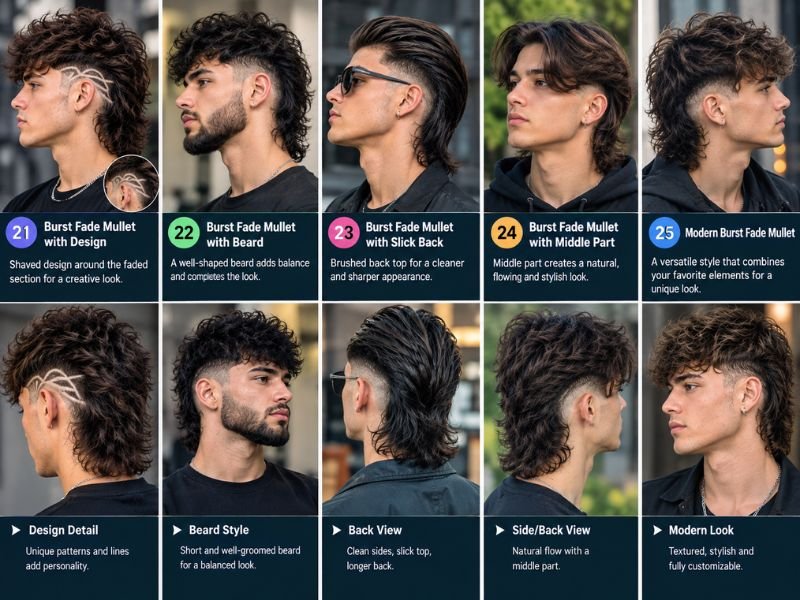
A shaved design can be added around the faded section for a more personalized appearance.
Simple curved lines, geometric patterns, or a small detail behind the ear can work with the rounded shape of the burst fade.Because designs grow out quickly, this version requires more frequent maintenance.
Best for: Anyone wanting a creative haircut
22. Burst Fade Mullet with Beard
A beard can make the haircut appear more complete by adding weight to the lower part of the face.
The beard does not need to be extremely long. A short, well-shaped beard can provide enough contrast against the clean burst fade.Keep the beard lines neat so they complement rather than compete with the haircut.
Best for: Oval, square, and diamond faces
23. Burst Fade Mullet with Slick Back
For a cleaner appearance, brush the longer top backward and explore our slick back hairstyle guide for additional styling ideas.
The slick-back finish creates a contrast between the polished top and the edgy mullet shape.Use a small amount of styling product and avoid making the hair excessively greasy.
Best for: Straight and thick hair
24. Burst Fade Mullet with Middle Part
A middle part creates a more flowing appearance.
The top is divided from the center and allowed to fall toward both sides, while the burst fade provides sharp contrast around the ears.This works especially well when the top is long enough to naturally separate.
Best for: Straight and wavy hair
Face shapes: Oval and heart
25. Modern Burst Fade Mullet
The modern version combines the elements you prefer rather than following one fixed formula.You can choose a low, mid, or high burst fade and combine it with textured layers, curls, fringe, a longer back, or a cleaner finish.
The key is keeping the haircut balanced so the fade, top, and back work together rather than looking like separate sections.
How to Choose the Right Burst Fade Mullet:
Choosing the right version depends mainly on your hair type, face shape, desired maintenance level, and how much length you want at the back.
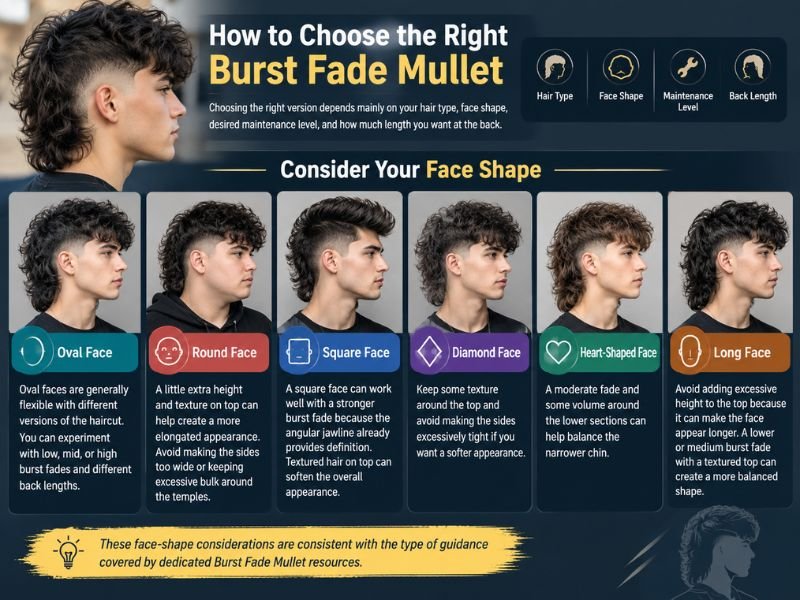
Consider Your Face Shape
Oval Face
Oval faces are generally flexible with different versions of the haircut.You can experiment with low, mid, or high burst fades and different back lengths.
Round Face
A little extra height and texture on top can help create a more elongated appearance.Avoid making the sides too wide or keeping excessive bulk around the temples.
Square Face
A square face can work well with a stronger burst fade because the angular jawline already provides definition.Textured hair on top can soften the overall appearance.
Diamond Face
Keep some texture around the top and avoid making the sides excessively tight if you want a softer appearance.
Heart-Shaped Face
A moderate fade and some volume around the lower sections can help balance the narrower chin.
Long Face
Avoid adding excessive height to the top because it can make the face appear longer.A lower or medium burst fade with a textured top can create a more balanced shape.
These face-shape considerations are consistent with the type of guidance covered by dedicated Burst Fade Mullet resources.
Burst Fade Mullet for Different Hair Types:
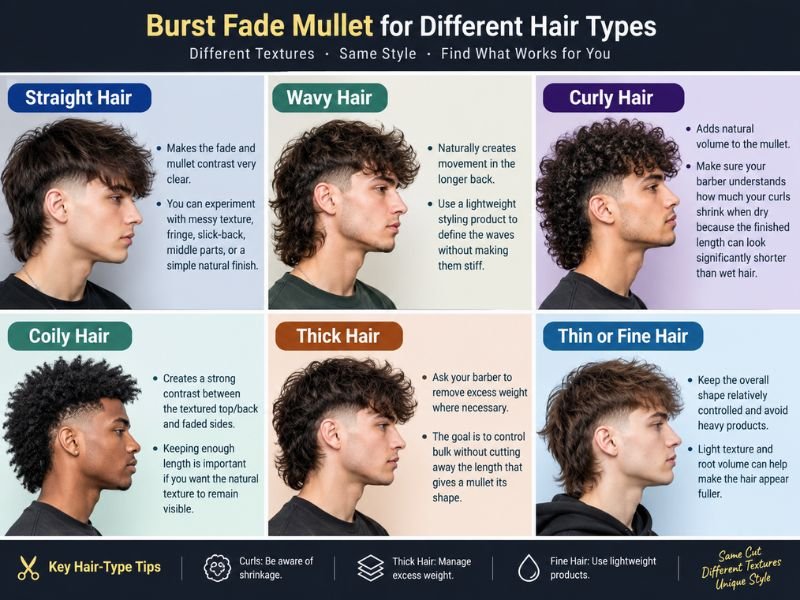
Straight Hair
Straight hair makes the fade and mullet contrast very clear.You can experiment with messy texture, fringe, slick-back, middle parts, or a simple natural finish.
Wavy Hair
Wavy hair naturally creates movement in the longer back.Use a lightweight styling product to define the waves without making them stiff.
Curly Hair
Curly hair adds natural volume to the mullet.
Make sure your barber understands how much your curls shrink when dry because the finished length can look significantly shorter than wet hair.
Coily Hair
Coily hair can create a strong contrast between the textured top/back and faded sides.Keeping enough length is important if you want the natural texture to remain visible.
Thick Hair
Ask your barber to remove excess weight where necessary.The goal is to control bulk without cutting away the length that gives a mullet its shape.
Thin or Fine Hair
Keep the overall shape relatively controlled and avoid heavy products.Light texture and root volume can help make the hair appear fuller.
Hair-type considerations such as shrinkage for curls, weight management for thick hair, and lightweight products for fine hair are also emphasized in current Burst Fade Mullet guides.
How to Ask Your Barber for a Burst Fade Mullet:
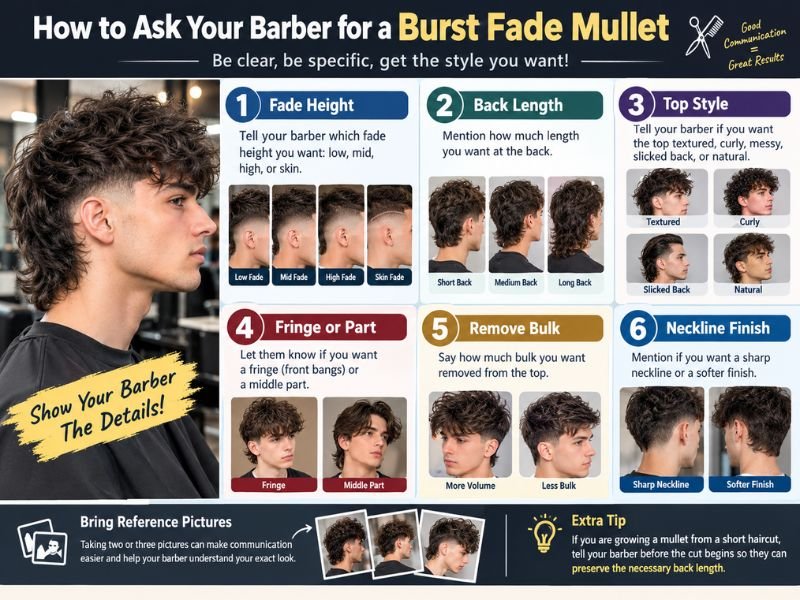
Instead of simply saying “Give me a Burst Fade Mullet,” explain the details.
Tell your barber:
- Which fade height you want: low, mid, high, or skin.
- How much length you want at the back.
- Whether you want the top textured, curly, messy, slicked back, or natural.
- Whether you want a fringe or middle part.
- How much bulk you want removed from the top.
- Whether you want a sharp neckline or a softer finish.
Taking two or three reference pictures can also make communication easier.
If you are growing a mullet from a short haircut, tell your barber before the cut begins so they can preserve the necessary back length.
How to Style a Burst Fade Mullet:
Styling depends on your hair texture and the finish you want.
For a Textured Look
Apply a small amount of matte clay or wax to dry or slightly damp hair. Work it through the top with your fingers and separate individual sections.
For Curly Hair
Apply curl cream to damp hair and use your fingers or a diffuser to enhance the natural curl pattern.
For a Messy Look
Use a lightweight texturizing product and shape the hair with your fingers rather than a comb.
For a Slick Back
Blow-dry the top backward and use a small amount of styling product to control the shape.
For Fine Hair
Use a lightweight volumizing product rather than heavy pomade. Too much product can flatten fine hair.
How Often Should You Maintain a Burst Fade Mullet?

The fade usually needs attention before the longer back does.
A practical schedule is:
| Style | Approximate Trim |
| Low Burst Fade Mullet | Every 4–5 weeks |
| Mid Burst Fade Mullet | Every 3–4 weeks |
| High Burst Fade Mullet | Every 1–3 weeks |
| Skin Burst Fade Mullet | Around every 1–2 weeks |
| Longer Mullet Back | Ends can be cleaned every 8–12 weeks |
The exact timing depends on how quickly your hair grows and how sharp you want the fade to remain. Current dedicated guides similarly recommend more frequent maintenance for higher and skin fades.
Common Burst Fade Mullet Mistakes:
Making the Back Too Long Too Quickly
If this is your first mullet, start with a moderate length. You can always grow it longer later.
Choosing the Wrong Fade Height
A very high fade creates much more contrast than a low fade. Choose the height based on the look you actually want.
Ignoring Your Hair Texture
Curly, coily, straight, and fine hair all behave differently. The same haircut does not produce exactly the same result on every texture.
Using Too Much Product
Heavy wax or pomade can make the top look greasy and remove the natural texture.
Forgetting Regular Trims
Even if you are growing the back, the faded sides still need maintenance.
Not Showing Your Barber a Reference
The phrase “modern mullet” can mean different things to different barbers. A reference photo makes your desired result much clearer.
These are also among the practical issues highlighted by current Burst Fade Mullet guides.
Burst Fade Mullet vs Regular Mullet:
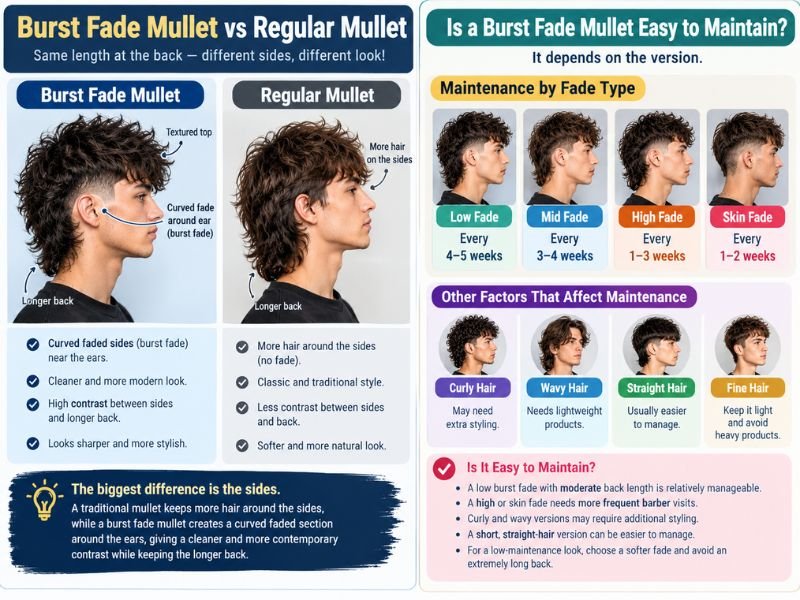
The biggest difference is the sides.
A traditional mullet generally keeps more hair around the sides, while a Burst Fade Mullet creates a curved faded section around the ears.
The burst fade therefore gives the haircut a cleaner and more contemporary contrast while keeping the longer back associated with the classic mullet.
Is a Burst Fade Mullet Easy to Maintain?
It depends on the version.
A low burst fade with moderate back length is relatively manageable. A high or skin fade requires more frequent barber visits because the contrast becomes noticeable as the sides grow out.
Curly and wavy versions may require additional styling, while a short straight-hair version can be easier to manage.If you want a low-maintenance version, choose a softer fade and avoid an extremely long back.
Is a Burst Fade Mullet Good for Men With Curly Hair?
Yes. Curly hair can work especially well with this haircut because the natural texture gives the longer top and back more volume.
The main consideration is shrinkage. Your barber should understand how your curls behave when dry and cut the length accordingly.
A diffuser and lightweight curl cream can help define the curls without making them stiff
Can You Grow a Burst Fade Mullet From a Short Haircut?
Yes.
If your current haircut is short, tell your barber that your goal is to grow a mullet. The barber can maintain the sides while allowing the back to gain length.
During the growing stage, regular shaping can prevent the haircut from becoming completely uneven.
Frequently Asked Questions:
What is a Burst Fade Mullet?
A Burst Fade Mullet combines a curved burst fade around the ears with longer hair at the back, creating a modern version of the traditional mullet.
Is a Burst Fade Mullet good for curly hair?
Yes. Curly hair adds natural volume and texture, although the barber should account for curl shrinkage when choosing the length.
What is the best burst fade for a mullet?
A low, mid, or high burst fade can work. The best choice depends on how much contrast you want, your face shape, and your preferred maintenance level.
How often should I get a Burst Fade Mullet trimmed?
Most versions need a trim every few weeks to keep the fade clean. Higher and skin fades generally need more frequent maintenance.
Can thin hair have a Burst Fade Mullet?
Yes. Keeping the sides shorter and using light texture can help create the appearance of more volume.
How long should the back be?
There is no single required length. If it is your first mullet, starting with moderate length is easier because you can always grow it longer.
Is a Burst Fade Mullet professional?
A low or moderate fade with a shorter back can look relatively understated, while a high fade, shaved designs, or a very long back creates a much more noticeable style.
Final Thoughts:
The Burst Fade Mullet gives you plenty of room to personalize the classic mullet. You can keep it short and subtle, grow the back long, add curls or waves, create messy texture, or go for a sharper high fade.
The most important things to consider are your hair type, face shape, desired back length, fade height, and maintenance routine.Show your barber clear reference photos and explain exactly how much length you want to keep.If you want a modern haircut with strong contrast and plenty of styling options, the Burst Fade Mullet is worth considering in 2026.