

A blowout haircut is a popular choice for men who want fuller-looking hair, natural movement, and a modern finish without limiting themselves to one specific style. It focuses on lifting the hair away from the scalp to create volume, while the sides can be shaped with a taper, fade, or a more natural finish. Whether your hair is straight, wavy, curly, thick, or fine, the right approach can help you achieve a look that suits your texture and personal style.
What makes this haircut interesting is its versatility. You can keep it short and simple for everyday wear or choose a textured top, a sharp fade, or a longer shape for a more noticeable appearance. In this guide, you will discover 25 stylish blowout haircut ideas for men in 2026, along with practical styling tips, barber instructions, and maintenance advice to help you choose a look that works for you.
What Makes a Blowout Haircut Different?
A blowout haircut is defined by the way the hair is shaped and styled to create visible volume, lift, and movement. Instead of keeping the top flat against the head, the hair is directed upward, outward, or slightly backward to create a fuller silhouette. The sides can remain natural or feature a taper, fade, or shorter finish, depending on the look.
The final result depends on three things: the length left on top, the natural texture of the hair, and the direction in which it is dried. This means two men can choose a blowout haircut and end up with noticeably different results. One may have a soft, rounded shape, while another prefers a textured top with sharply defined sides.
The following 25 styles explore different ways to wear a blowout haircut, from subtle everyday options to more noticeable combinations with fades, curls, and longer tops.
25 Best Blowout Haircut Styles for Men:
1. Classic Blowout Haircut
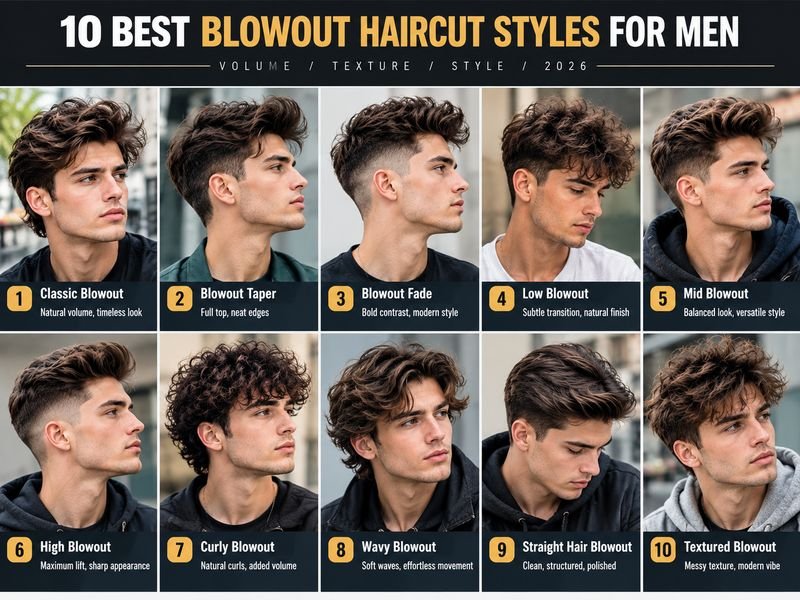
The classic blowout keeps the emphasis on volume rather than complicated cutting details. The hair on top is left long enough to lift away from the scalp, while the sides are shaped to maintain a balanced outline.
This version works well for men who want a fuller appearance without committing to an aggressive fade. A light styling product helps preserve movement, allowing the hair to look shaped rather than stiff.
2. Blowout Taper Haircut
A blowout taper combines a voluminous top with gradually shortened hair around the temples, sideburns, and neckline. Unlike a full fade, the taper can remain concentrated around these edges, leaving more fullness on the sides.
The combination creates a neat outline without taking attention away from the top. Choose a low taper for a subtle finish or a higher taper for a more noticeable contrast.
3. Blowout Fade Haircut
The blowout fade creates a stronger difference between the longer hair above and the shorter sides. The fade gradually blends the sides into shorter lengths, allowing the volume on top to stand out.
You can choose a low, mid, or high fade depending on how much contrast you prefer. A low fade gives the haircut a softer outline, while a high fade produces a sharper appearance.
4. Low Blowout Haircut
A low blowout keeps the shorter section close to the lower edges of the haircut. More hair remains around the upper sides, making the transition between the top and sides less dramatic.
This option suits men who like volume but do not want an overly sharp finish. It also offers flexibility because the top can be styled forward, upward, or slightly backward.
5. Mid Blowout Haircut
The mid blowout places the shorter section around the middle of the sides, creating a balanced relationship between the top and the fade. It is more noticeable than a low blowout but does not extend as high as a high fade.
This makes it a useful choice for men who want visible contrast without making the sides the main feature. Keep the top textured for a relaxed finish or brush it upward for a more defined shape.
6. High Blowout Haircut
A high blowout features shorter sides that extend farther upward, leaving the longer hair concentrated near the top. This creates a bold outline and makes the volume more prominent.
The style works particularly well when the top has enough length to maintain its shape. Ask your barber to blend the sides carefully so the transition complements your head shape instead of appearing disconnected.
7. Curly Blowout Haircut
A curly blowout allows natural curls to provide most of the volume. Rather than forcing the hair into a straight shape, the haircut preserves the curl pattern while controlling the sides and overall silhouette.
A suitable curl cream or lightweight leave-in product can help define the curls. When drying, use a diffuser on a gentle setting to reduce disruption to the natural texture.
8. Wavy Blowout Haircut
Wavy hair naturally creates movement, making it a good match for a blowout. The top can be directed upward and slightly backward while the waves retain their natural bends.
Avoid brushing the hair too aggressively if you want to preserve its texture. A light styling cream can provide control without removing the relaxed appearance that makes this version attractive.
9. Straight Hair Blowout
Straight hair can produce a clean, structured blowout when the roots are lifted correctly during drying. The main challenge is keeping the hair from returning to a flat position.
Apply a heat protectant and use a hairdryer to direct the roots upward. A lightweight volumizing product can improve lift without making the hair look greasy or heavy.
10. Textured Blowout Haircut
The textured blowout uses separated sections and uneven-looking movement to create a less polished finish. The hair is not arranged into one smooth shape; instead, individual strands contribute to a fuller, more natural appearance.
This option is particularly useful for men who prefer a modern, casual style. A small amount of matte paste can define the texture while keeping the top flexible.
11. Messy Blowout Haircut
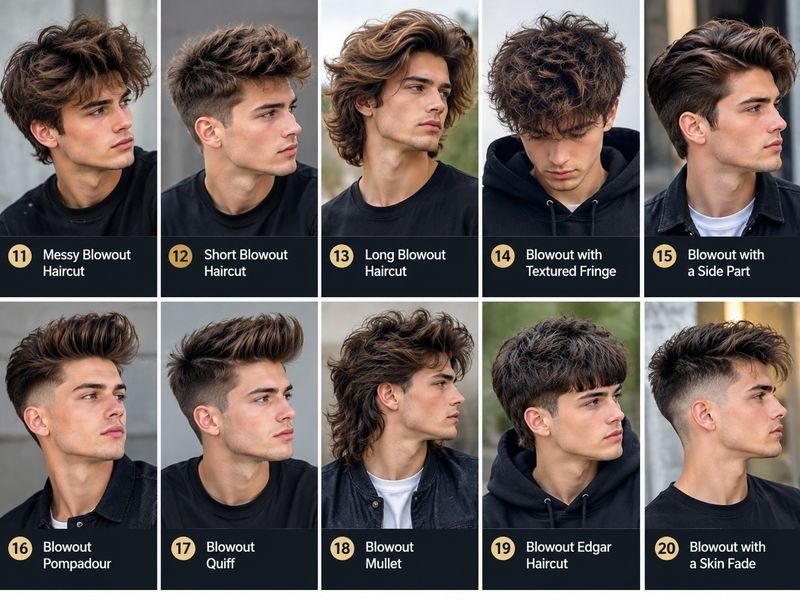
A messy blowout combines volume with an intentionally relaxed arrangement. Some sections may point upward, while others move slightly forward or sideways.
The key is to create controlled messiness rather than an unshaped appearance. Dry the hair with your fingers, then use a small amount of styling paste to separate the strands without flattening them.
12. Short Blowout Haircut
A short blowout is designed for men who want some lift without maintaining a long top. The hair is kept relatively short but shaped to rise slightly from the roots.
Although it will not produce the same dramatic volume as a longer version, it can still create a noticeable difference in the haircut’s silhouette. This is a practical option for men who prefer shorter hairstyles.
13. Long Blowout Haircut
A long blowout leaves additional length on top, allowing more movement and a fuller shape. The hair can be brushed upward, swept backward, or directed outward depending on its natural growth pattern.
Longer hair usually requires more drying time and a little extra control. Use a round brush or your fingers to guide the shape, and avoid applying too much product near the roots.
14. Blowout Haircut with Textured Fringe
This variation combines a lifted top with a fringe that falls toward the forehead. The contrast between the raised sections and forward-moving fringe gives the haircut a distinctive shape.
It works best when the front has enough length to create separation without covering the eyes. A light matte product can keep the fringe defined while preserving movement throughout the top.
15. Blowout Haircut with a Side Part
A side-part blowout introduces direction into the hairstyle. Instead of lifting all the hair in the same direction, the top is separated along one side and styled to create controlled volume.
This creates a more organised finish while retaining the fullness associated with a blowout. It is a suitable option for men who want a style that can work with both casual and smarter outfits.
16. Blowout Pompadour
The blowout pompadour places extra emphasis on height at the front. The hair is lifted from the roots and guided backward, creating a raised shape that gradually settles toward the crown.
The front section needs sufficient length to maintain the shape. Use a round brush while blow-drying, then apply a small amount of flexible-hold product to keep the style in place without making it rigid.
17. Blowout Quiff
A blowout quiff combines a raised front section with a top that gradually follows the natural direction of the hair. Compared with a more uniform blowout, the quiff gives the front a stronger visual focus.
The height can be subtle or more pronounced, depending on your preference. A medium-length top generally provides enough flexibility to create the shape without excessive styling.
18. Blowout Mullet
The blowout mullet combines a voluminous top with additional length at the back. The sides may be tapered or faded, while the rear section remains longer to create the mullet silhouette.
The result is more distinctive than a traditional blowout because the back contributes to the overall shape. Ask your barber to balance the top and rear lengths so neither section looks disconnected from the other.
19. Blowout Edgar Haircut
A blowout Edgar combines the raised volume of a blowout with the more defined front edge associated with an Edgar cut. The top can retain texture, while the fringe is cut into a relatively straight or sharply shaped line.
The final appearance depends on how much height and texture you keep above the fringe. This combination is best discussed with a barber who can balance the front shape with your natural hairline.
20. Blowout with a Skin Fade
A skin-fade blowout takes the sides down to the skin at the shortest point. The longer top then creates a pronounced contrast against the closely shaved sides.
Because the fade is visually strong, the blending needs to be clean and even. This version is suitable for men who prefer a sharp, high-contrast haircut rather than a softer transition.
21. Blowout with a Temple Fade
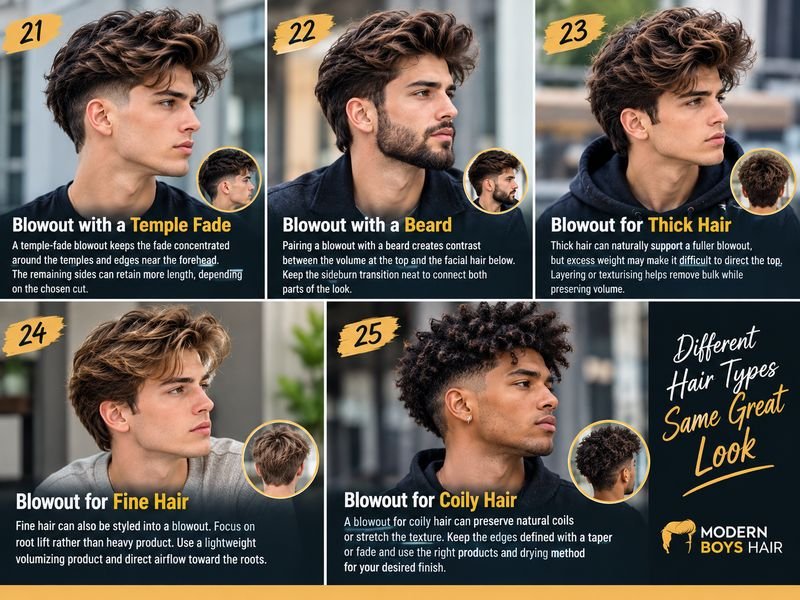
A temple-fade blowout keeps the fade concentrated around the temples and the edges near the forehead. The remaining sides can retain more length, depending on the chosen cut.
This approach gives the hairline a clean finish without necessarily removing much fullness from the sides. It is a useful option when you want a defined outline but prefer the top and sides to remain connected.
22. Blowout with a Beard
Pairing a blowout with a beard creates contrast between the volume at the top and the facial hair below. The beard can be short and neatly trimmed or fuller, depending on your preferred appearance.
The important detail is balance. A high-volume top may pair well with a clearly shaped beard, while a softer blowout can work with a more natural beard outline. Keeping the sideburn transition neat helps connect both parts of the look.
23. Blowout for Thick Hair
Thick hair can naturally support a fuller blowout, but excess weight may make it difficult to direct the top. A barber can remove some bulk through careful layering or texturising while preserving enough length for volume.
During styling, work in sections rather than trying to lift all the hair at once. Use a moderate amount of product so the strands remain separated and the top does not become heavy.
24. Blowout for Fine Hair
Fine hair can also be styled into a blowout, although the technique should focus on root lift rather than excessive product. Keeping the haircut appropriately shaped helps the top look fuller without requiring a large amount of length.
Apply a lightweight volumizing product to damp hair and direct the airflow toward the roots. Finish with a light-hold product if needed, avoiding heavy waxes or creams that can make the hair fall flat.
25. Blowout for Coily Hair
A blowout for coily hair can take different forms depending on whether you want to preserve the natural coils or temporarily stretch the texture. The top may be shaped into a rounded silhouette, while a taper or fade keeps the edges defined.
If you want to retain your natural coils, use a suitable moisturising product and a gentle drying method. If you prefer a stretched finish, discuss the required length, heat protection, and styling technique with a professional barber.
How to Style a Blowout Haircut at Home:
The haircut provides the basic shape, but the styling process creates the lifted finish. Follow these steps to achieve a consistent result.
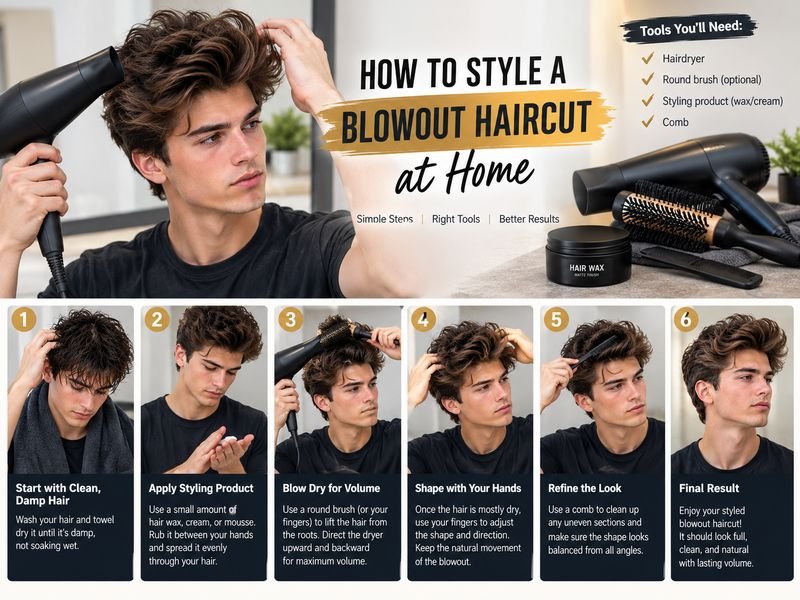
Step 1: Start with Clean, Damp Hair
Wash your hair when necessary and gently towel-dry it. The hair should be damp rather than dripping wet, allowing you to control its direction during drying.
Step 2: Apply Heat Protectant
Distribute a heat-protectant product through the hair before using a hairdryer. Follow the product instructions and avoid applying more than necessary.
Step 3: Lift the Roots
Use your fingers or a round brush to raise the hair from the scalp. Direct the airflow toward the roots and move gradually through each section.
Step 4: Shape the Top
Guide the hair upward, backward, or outward according to the style you selected. Keep the movement consistent so the finished shape looks intentional rather than uneven.
Step 5: Set the Style
Allow the hair to cool before applying a small amount of styling paste, cream, or another suitable product. Use your fingers to refine the shape without pressing down the volume.
What to Tell Your Barber:
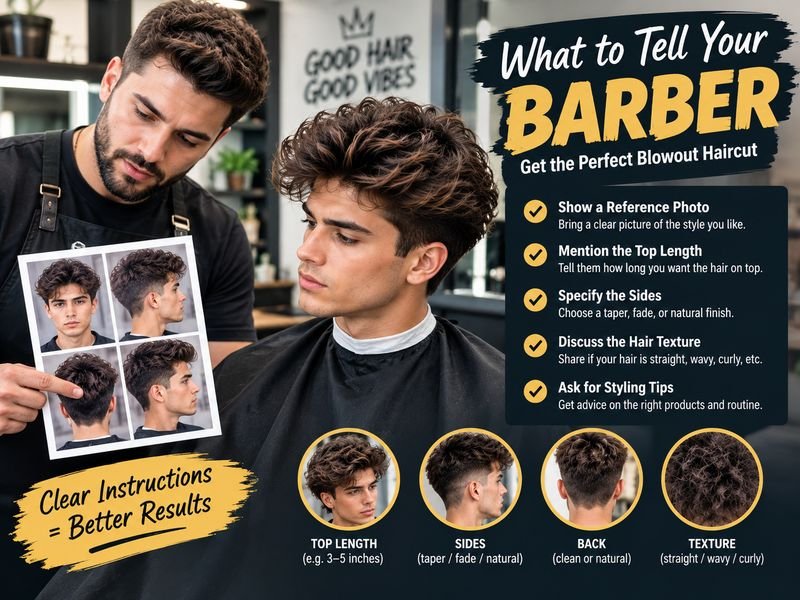
Explaining the desired shape is more useful than asking for a blowout haircut by name alone. The term can describe several different combinations of top length, taper height, and styling direction.
Before your appointment, decide how much volume you want, how short the sides should be, and whether you prefer a taper or a fade.
You can use this simple instruction:
“I want a blowout haircut with enough length on top to create volume. Keep the sides blended at the height I choose, and shape the top to suit my natural hair texture. Please leave enough length for me to style it at home.”
Bring a reference photo that shows the front and sides of the haircut. This helps your barber understand the proportions you want and adjust the cut to your hair type.
How to Maintain a Blowout Haircut:
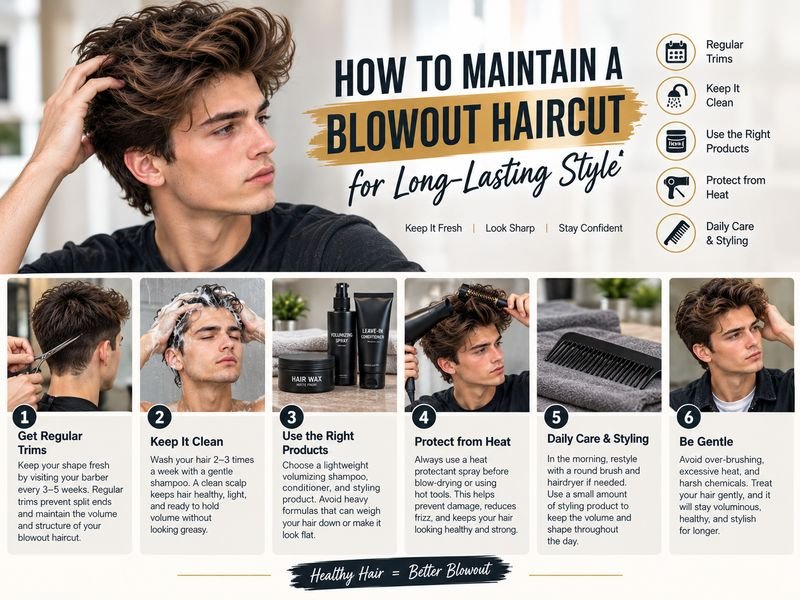
Maintaining the style involves both the haircut and the daily styling routine.
- Keep the outline tidy: Schedule trims according to how quickly your hair grows and how sharp you want the sides to look.
- Avoid heavy products: Too much wax or cream can weigh down the top and reduce its volume.
- Use heat carefully: Apply heat protectant and avoid unnecessarily high temperatures.
- Preserve natural texture: Choose products that work with your curls, waves, or straight hair rather than fighting them.
- Refresh the shape: On days when your hair loses volume, lightly dampen it and restyle the roots instead of adding repeated layers of product.
Frequently Asked Questions:
1. What Is a Blowout Haircut?
A blowout haircut is a style that uses lifted, voluminous hair on top to create a fuller silhouette. The sides can be tapered, faded, or kept relatively natural.
2. Is a Blowout Haircut the Same as a Blowout Taper?
No. A blowout describes the volume and styling of the hair, while a taper refers to gradually shorter hair around the temples, sideburns, and neckline. A blowout taper combines both features.
3. Is a Blowout Haircut Good for Curly Hair?
Yes. Curly hair can create natural volume and texture. A suitable cut and gentle styling method help preserve curl definition while controlling the overall shape.
4. How Long Does Hair Need to Be for a Blowout?
The required length depends on the desired result and your hair texture. Some short versions need only modest length, while more dramatic styles require additional length to create height and movement.
5. What Products Help Style a Blowout Haircut?
A heat protectant is useful before blow-drying. Depending on your hair type, a lightweight volumizing product, styling cream, or matte paste can help shape and maintain the finish.
6. How Often Should You Trim a Blowout Haircut?
The timing depends on the length of your sides and the sharpness you want to maintain. Faded versions generally need more frequent edge clean-ups than softer, longer styles.
7. Can Fine Hair Have a Blowout Haircut?
Yes. Focus on lifting the roots, choosing a suitable length, and using lightweight products. Heavy styling products can make fine hair look flatter.
Final Thoughts:
A blowout haircut offers more than one fixed appearance. Its defining feature is the volume created through the right combination of cutting, drying, and shaping. A taper or fade can sharpen the outline, while curls, waves, fringe, and longer sections change the overall character of the style.
The best version is the one that works with your natural hair texture, the amount of styling you are willing to do, and the shape you want to maintain. Choose a reference that matches your hair as closely as possible, explain the desired top length and side finish to your barber, and use a consistent drying technique to recreate the look at home.