
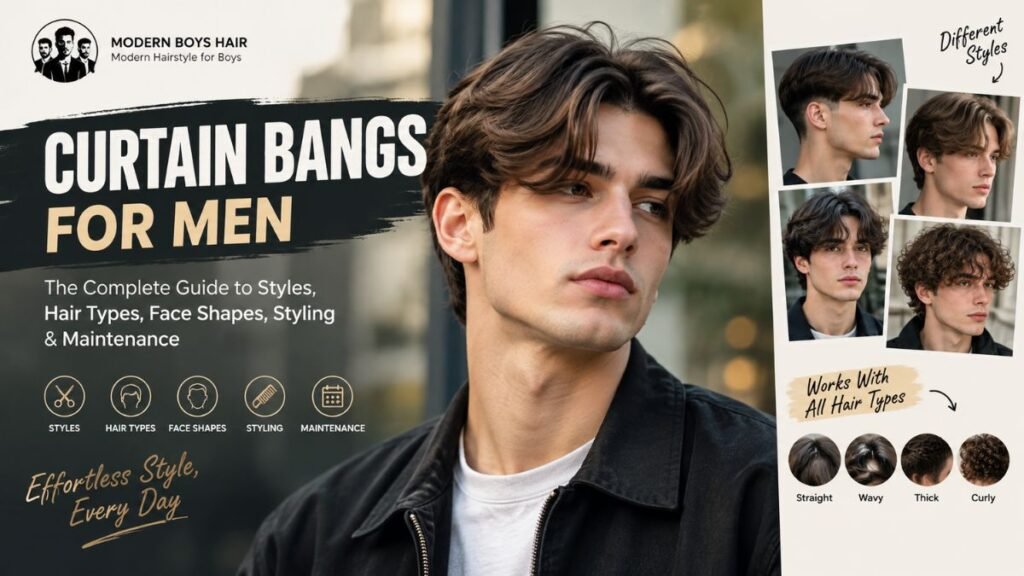
A curtain bangs haircut keeps the front of your hair longer and parts it down the middle or just slightly off-center so it falls softly around both sides of your face, the way curtains frame a window. The sides and back can be cut short, tapered, or left longer, which is why the style adapts so easily.
Curtain bangs for men have grown from a niche throwback into one of the most requested cuts in barbershops. It suits schoolboys and grown men alike, works with straight, wavy, and thick hair, and doesn’t demand an hour in front of the mirror. In this guide, you’ll learn what the cut involves, which variations suit which hair types and face shapes, how to style it, and how to maintain it.
What Is a Curtain Bangs Haircut?
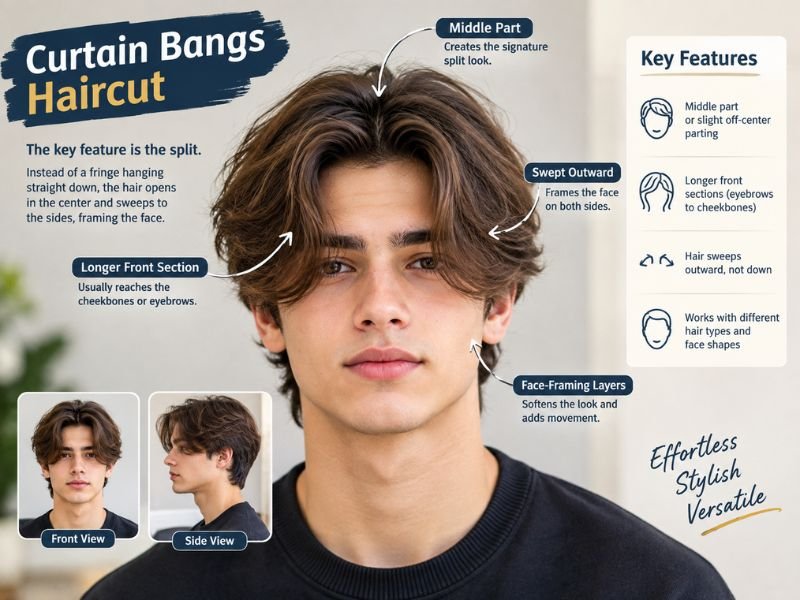
A curtain bangs haircut (sometimes called a curtain haircut or curtain fringe) leaves the front section noticeably longer than the rest, usually reaching the cheekbones or eyebrows. That longer section is parted in the middle or just off-center, then brushed outward so the hair frames each side of the face.
The key feature is the split. Instead of a fringe hanging straight down, the hair opens in the center and sweeps to the sides. Length, texture, and the sides can all be adjusted, so two people with “curtain bangs” can end up with very different haircuts.
Why Are Curtain Bangs Haircut Popular for Men?
The main appeal is how relaxed the style looks. Curtain bangs read as effortless hair that’s been shaped well but not styled to death. For teenagers and young men especially, that casual finish is the point.
Versatility comes second. The same haircut can look neat for school, then messier on the weekend, and it plays well with a fade, a taper, or added texture. Because the bangs grow out into a soft middle part rather than an awkward overhang, the cut stays presentable for weeks. Straight, wavy, and thick hair all handle the shape.
Best Curtain Bangs Haircut for Men:
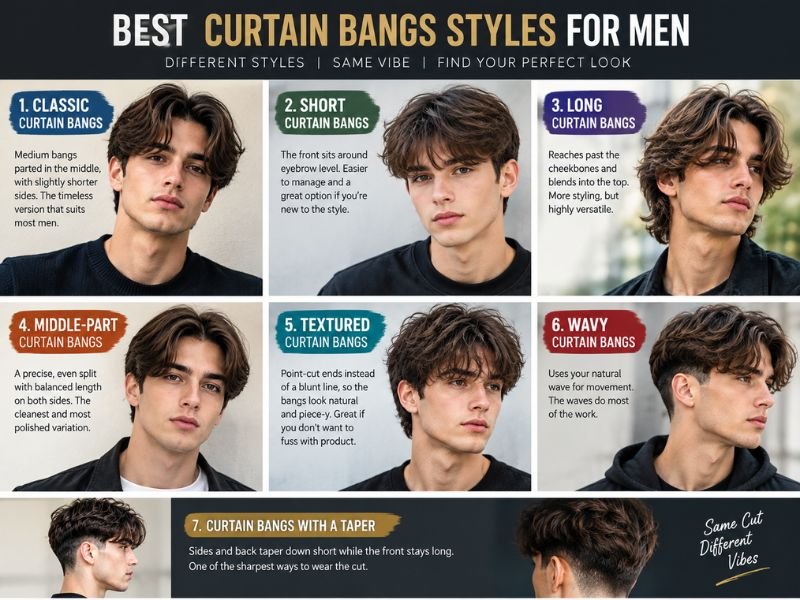
- Classic curtain bangs. Medium bangs parted cleanly in the middle, sides a little shorter. The version most people picture.
- Short curtain bangs. The front sits around eyebrow level. Easier to manage a good first step.
- Long curtain bangs. The front reaches past the cheekbones and blends into the top. More styling, but the most versatile.
- Middle-part curtain bangs. A precise, even split with balanced length on both sides. The cleanest variation.
- Textured curtain bangs. Point-cut ends instead of a blunt line, so the bangs look piece-y and natural. Great if you don’t want to fuss with product.
- Wavy curtain bangs. The same cut, leaning on natural wave for movement. The waves do most of the work.
- Curtain bangs with a taper. Sides and back taper down short while the front stays long one of the sharpest ways to wear the cut.
Curtain Bangs Haircut for Different Hair Types:
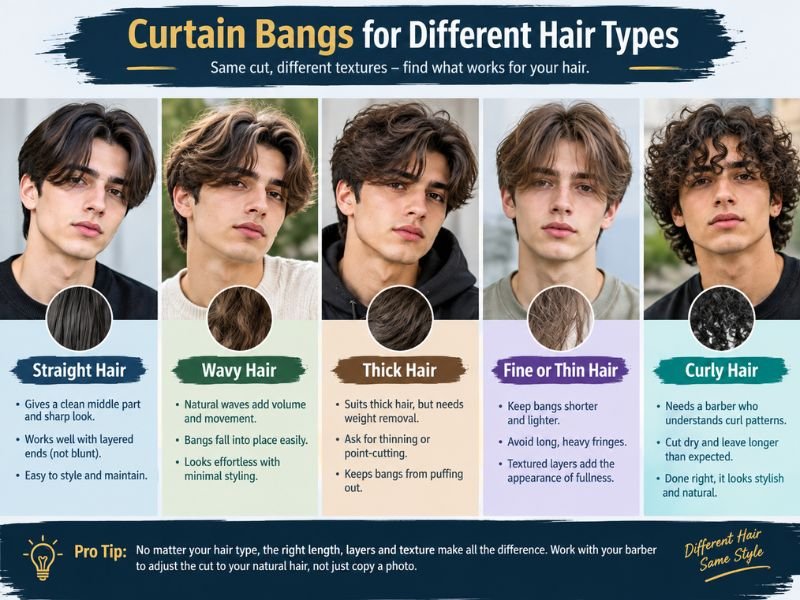
Straight hair. Straight hair gives you the cleanest middle part, which is why curtain bangs for straight hair look so sharp. The trade-off: a blunt cut line shows clearly, so ask for soft, layered ends rather than one heavy block of fringe.
Wavy hair. Curtain bangs for wavy hair are the easiest combination. The wave adds natural separation and volume, so the bangs fall into place with little effort. Leave a bit of extra length waves shrink as they dry.
Thick hair. The cut suits thick hair, but weight is the enemy. Ask your barber to remove bulk with thinning or point-cutting so the bangs drape instead of puffing out. Our guide to thick hair for men covers more ways to manage it.
Fine or thin hair. Keep the bangs shorter and lighter. Long, fine bangs look flat and stringy, while a shorter, textured version adds the appearance of fullness.
Curly hair. Tight curls need a barber who works with curl patterns. The bangs must be cut dry and left longer than you’d expect, because curls contract significantly. Done right, curly curtain bangs look excellent; rushed, they turn into a triangle.
Curtain Bangs Haircut for Different Face Shapes:
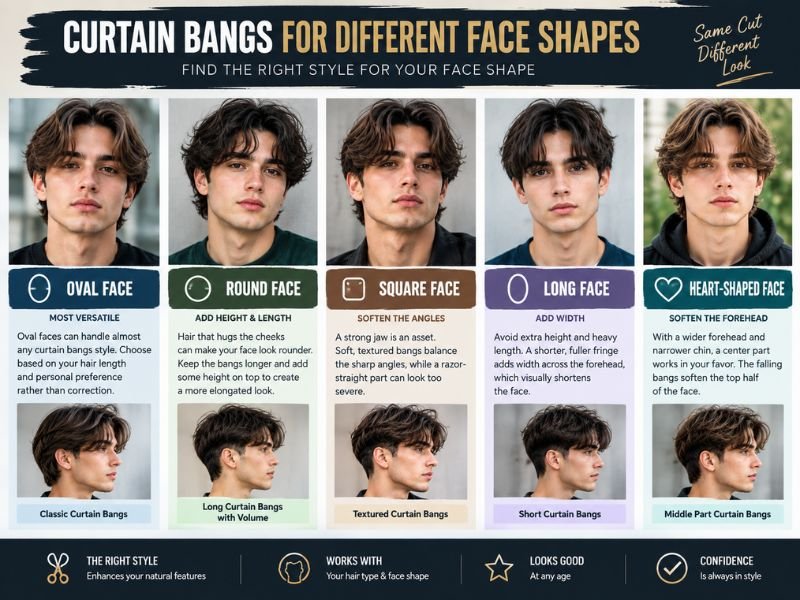
Oval faces. Oval handles almost any version of the cut, so choose by length preference rather than correction.
Round faces. Hair that hugs the cheeks can emphasize roundness. Keep the bangs longer and add some height on top so the face reads longer rather than wider.
Square faces. A strong jaw is an asset here. Soft, textured bangs balance the sharp angles, while a razor-straight part can look severe.
Long faces. Avoid extra height and heavy length. A shorter, fuller fringe adds width across the forehead, which visually shortens the face.
Heart-shaped faces. With a wider forehead and narrower chin, a center part works in your favor the falling bangs soften the top half of the face.
Short vs. Long Curtain Bangs Haircut:
Short curtain bangs sit at or just above the eyebrows. They dry faster, need less product, and stay out of your eyes practical for sports, school, and anyone new to styling their hair.
Long curtain bangs reach the cheekbones or beyond. They look more dramatic and can be pushed back or tucked behind the ears, but they need daily blow-drying and more frequent trims.
If you’re unsure, start just below the eyebrows. You can always grow them longer; cutting back from long takes patience.
How to Style Curtain Bangs Haircut:
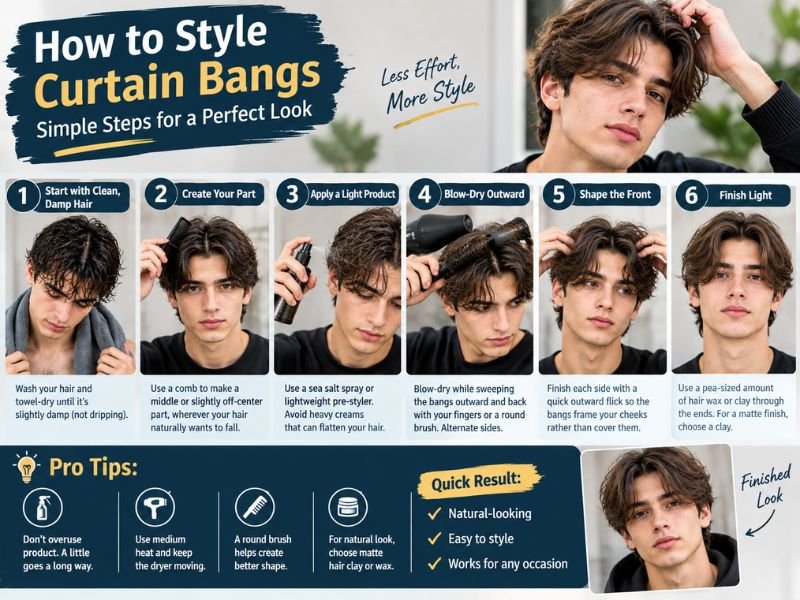
Curtain bangs styling is simpler than it looks:
- Start with clean, slightly damp hair. Towel-dry until it’s not dripping.
- Create your part. Comb the hair into a middle or slightly off-center part, wherever it naturally wants to fall.
- Apply a light product if needed. A little sea salt spray or lightweight pre-styler helps hold the shape. Heavy creams flatten fine hair.
- Blow-dry with direction. Sweep the bangs outward and back with your fingers or a round brush, alternating sides. The airflow direction sets the “curtain” shape.
- Shape the front away from your face. Finish each side with a quick outward flick so the bangs frame your cheeks rather than cover them.
- Finish light. A pea-sized amount of hair wax for men through the ends adds definition without making the bangs look heavy. For a matte finish, the best hair clay for men gives hold without shine.
How to Ask Your Barber for a Curtain Bangs Haircut:
Barbers respond to specifics, so bring a clear description or a photo. Cover four things:
- Front length: where the bangs should end eyebrows, cheekbones, or longer.
- Parting: dead center or slightly off to one side (most heads part more naturally off-center).
- Texture: blunt ends for a defined edge, or point-cut for a softer, piece-y look.
- Sides and back: how short, and whether you want a taper or fade connecting to the top.
One sentence that works: “Middle-part curtain fringe, cheekbone length, point-cut so it’s not blunt, with a low taper on the sides.”
How to Maintain Curtain Bangs Haircut:
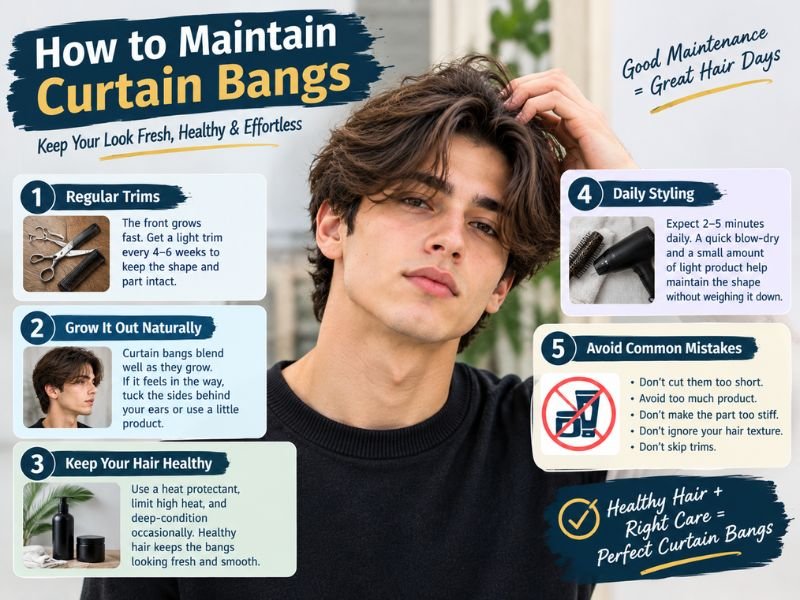
Trims. The front shows growth fastest. Plan a light trim every four to six weeks to keep the length and part intact.
Growing out. Curtain bangs are one of the friendliest cuts to grow out the bangs gradually merge into a longer middle part instead of hanging in your eyes. If the in-between stage bothers you, tuck the sides behind your ears or use a touch of product.
Hair health. The front takes the most heat, so use a heat protectant or lower dryer settings, and deep-condition occasionally if your hair runs dry.
Daily effort. Expect two to five minutes of styling. Wavy and textured hair can often skip the blow-dryer; straight, thick hair usually needs it to hold the part.
Common Curtain Bangs Haircut Mistakes to Avoid:
- Cutting the bangs too short. The style depends on enough length to part and sweep. Start too short and you’re left with a plain fringe.
- Using too much product. Heavy wax or cream weighs the bangs down and kills the airy look.
- A stiff, exaggerated part. A razor-sharp center line can look dated. A slightly relaxed part usually looks better.
- Ignoring your texture. Copying a photo of fine, straight hair when yours is thick and wavy leads to disappointment. Ask the barber to adapt the cut, not replicate it.
- Skipping trims. After two months the shape quietly collapses. A quick fringe trim keeps the cut alive.
- Fighting your natural part. If your hair insists on falling left of center, work with it an off-center curtain fringe looks just as good.
FAQS for Curtain Bangs Haircut:
Are Curtain Bangs Haircut good for men?
Yes. The cut suits a wide range of ages, hair types, and face shapes, and can be styled neat or casual.
How long should men’s Curtain Bangs Haircut be?
Most versions sit between eyebrow and cheekbone length. You need roughly three to four inches of front length for the hair to part and sweep properly.
Can I get Curtain Bangs Haircut with straight hair?
Absolutely straight hair makes the cleanest middle part. Ask for layered, point-cut ends so the bangs don’t look like one heavy block.
Are Curtain Bangs Haircut easy to style?
For most people, yes. A quick blow-dry directing the bangs outward takes under five minutes, and wavy hair often needs nothing more than a towel dry and a finger-comb.
How do I maintain a curtain bangs haircut?
A light trim every four to six weeks, moderate heat styling, and a small amount of product daily will keep the shape looking intentional.
Can curtain bangs work with a taper?
Yes long, parted bangs with a taper or low fade at the sides creates strong contrast, and it suits thick and straight hair particularly well.
Conclusion:
Curtain bangs for men are a flexible haircut that can work with different hair types, face shapes, and personal styles. Whether you have straight, wavy, thick, fine, or curly hair, the cut can be adjusted to suit your natural texture. You can also choose between short, long, textured, classic, or tapered curtain bangs depending on how much styling you want.
The key is getting the right front length, working with your natural part, and avoiding too much product. With regular trims and a few minutes of styling, curtain bangs can give you a relaxed, modern look without requiring a complicated routine. If you’re considering this haircut, show your barber a clear reference photo and ask them to adapt the style to your hair rather than copying it exactly.