
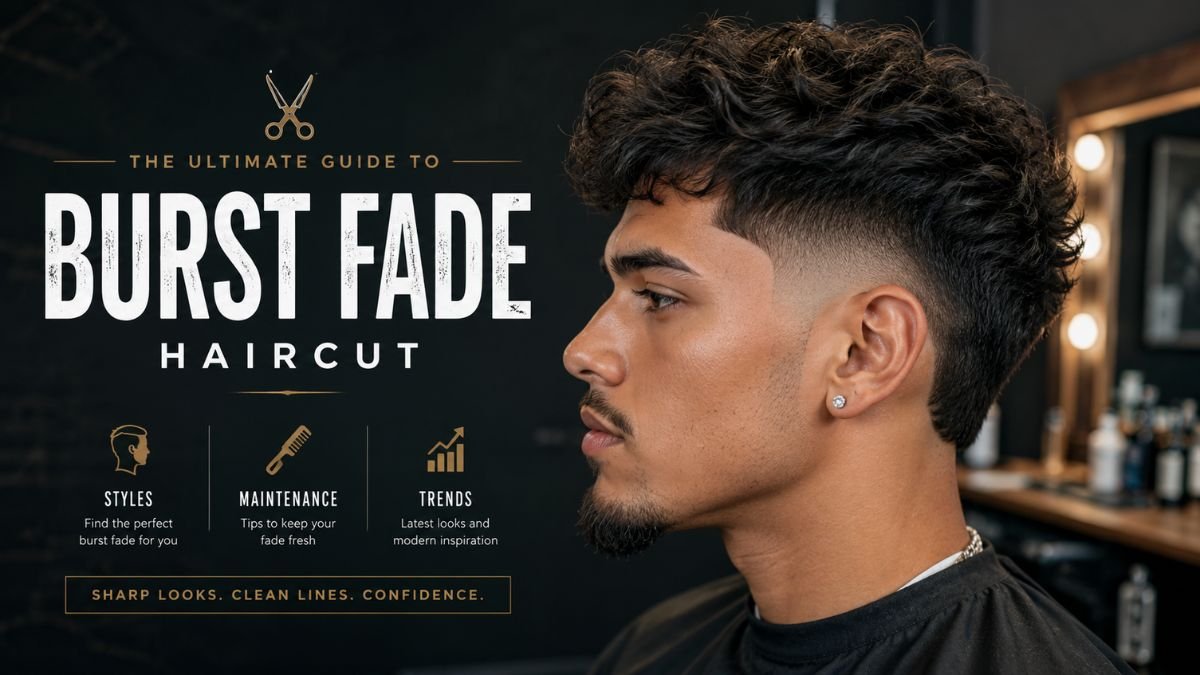
Finding a haircut that balances bold individuality with a clean, professional aesthetic can feel like an endless search. Traditional fades often feel too rigid, while longer, unstructured styles can lack the sharp definition required for a polished appearance. This is where the burst fade haircut changes the game, offering a dynamic, circular taper that curves gracefully around the ear. By blending modern streetwear edge with classic barbering techniques, this style provides an instantly recognizable profile that enhances your natural hair texture while framing your face with striking precision.The burst fade haircut has quickly become one of the most popular hairstyles for men who want a clean yet modern appearance.
Choosing the right variation of this cut requires understanding how different lengths, textures, and heights interact with your specific hair type and facial structure. Whether you are dealing with coarse, curly, straight, or fine hair, the way the gradient tapers down to the skin can entirely alter your look. This comprehensive guide breaks down every aspect of the modern burst fade haircut, providing actionable styling advice, clear maintenance routines, and real-world examples so you can confidently walk into your next barber appointment and get exactly what you want.
Our Practical Tip:
Our Practical Tip: Before getting a burst fade haircut, consider your face shape, hair texture, and how much contrast you want around the sides and back. The burst fade works especially well when the fade is adjusted to follow the natural shape around the ears. Ask your barber to keep the top length suitable for your preferred style, whether you want curls, a textured look, or a more polished finish.
Understanding the Anatomy of a Burst Fade Haircut:
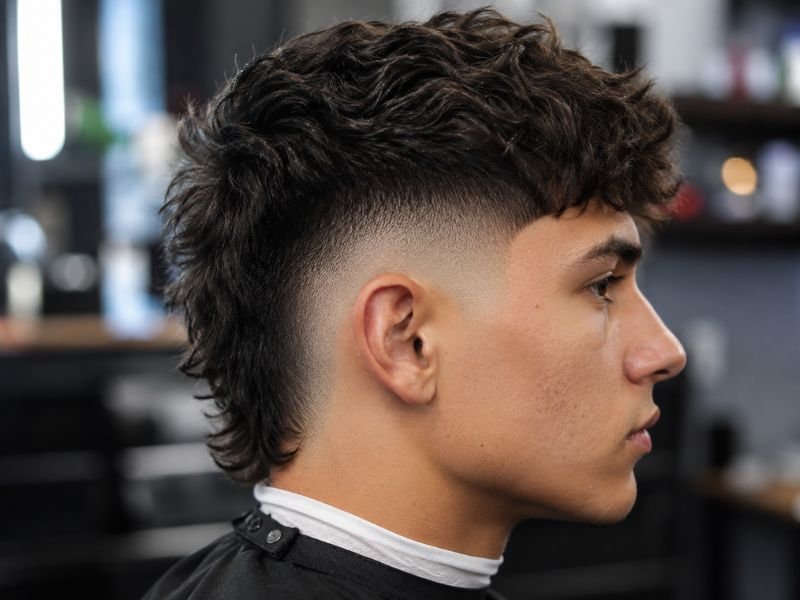
To truly appreciate this style, you need to understand exactly what a barber burst fade does to your hair silhouette. Unlike a drop fade or a traditional high fade that cuts a straight, horizontal line around the back of the skull, this technique isolates the area directly surrounding the ear. The taper radiates outward like a sunburst, leaving the hair at the nape of the neck and along the crown significantly longer.
The Curve Technique Burst Fade Haircut
The defining characteristic of a burst fade haircut is its semi-circular arc around the ear.. The barber starts the shortest point of the fade right at the ear, gradually creating a smooth gradient that blends seamlessly into the longer hair above and behind it. This leaves a full shadow of hair running down the center of the head, mimicking the shape of a mohawk but with a much softer, more versatile transition.
Example: Think of it like a spotlight shining directly behind your ear; the center is bright and clear (skin), while the light softly darkens and diffuses into a deep shadow as it spreads outward into the rest of your hair.
Contrast and Density Management Burst Fade Haircut
Managing hair density around the ears is crucial for preventing a bulky, unbalanced look. Your barber uses a precise combination of clippers, guards, and texturizing shears to ensure that the transition from bare skin to dense length doesn’t happen too abruptly. This creates a balanced distribution of weight, keeping the sides tight while emphasizing the natural volume on top.
Example: If you have dense, coarse hair, a barber will use deep point-cutting techniques within the transition zone so that the thick top sections lie completely flat against the faded curvature rather than sticking straight out.This is one reason why the burst fade haircut looks clean and balanced on different hair types.
Popular Variations of the Modern Burst Fade Haircut:
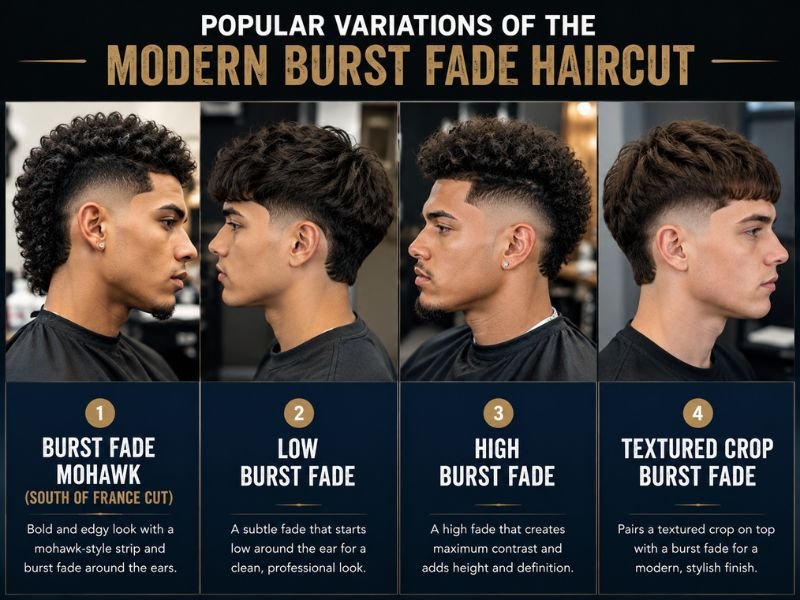
The beauty of the modern burst fade haircut lies entirely in its adaptability. It is not a rigid, one-size-fits-all formula; it can be customized to match your personal style, workplace environment, and daily maintenance preferences. Below are the most prominent variations dominating contemporary grooming.Every burst fade haircut variation offers a unique look depending on your hair texture and personal style.
1. The Burst Fade Mohawk (South of France Cut)
This burst fade haircut variation is perfect for bold personalities.Pop-culture icons and athletes have made this specific variation incredibly popular. It keeps a wide band of hair running completely from the forehead all the way down to the collar of the neck, while the sides are cleanly burst-faded right down to the skin.
- Best For: Coarse, curly, and coily hair textures.
- Styling Tip: Use a twisting sponge or a curl-defining cream on the top section to give the central band distinct structure and pop.
Example: Imagine a classic mohawk, but instead of the sides being completely shaved harsh and bare, they feature a smooth, smoky shadow that curves gracefully around the ears.
2. The Low Burst Fade Haircut
For individuals who want to test the waters without committing to a high-contrast style, the low version is an excellent choice. The skin-tapering effect is kept tightly confined to the immediate perimeter of the ear, leaving more hair length on the sides of the head.
- Best For: Straight or wavy hair types, and professionals working in conservative office environments.
- Styling Tip: Apply a light matte clay to keep the side lengths neat and brushed down.
Example: A graphic designer who needs a tidy look for client presentations but still wants a hint of modern style chooses a low fade that keeps his hair clean around the ears while leaving plenty of length to sweep back neatly on top.
3. The High Burst Fade Haircut
This variation pushes the circular fade line much higher up the sides of the skull, closer to the crown. It creates a bold, high-contrast look that narrows the face and draws maximum attention to the height and volume of the hair on top.
- Best For: Round or oval face shapes that benefit from added visual height.
- Styling Tip: Use a blow dryer and a firm-hold pomade to maximize volume at the roots.
Example: A university student looking for a sharp, high-energy aesthetic pairs a high fade with a texturized crop on top, making the sides look bright and clean while the top sections stand out vividly.
4. Texturized Crop with Burst Fade Haircut
This style pairs a blunt, forward-fringe crop with the signature curved fade on the sides. It creates an interesting play on geometric lines a straight line across the forehead contrasted against a circular arc around the ears.
- Best For: Straight, fine, or thinning hair, as the forward texture creates the illusion of thicker hair density.
- Styling Tip: Dust a small amount of texture powder into dry hair and piece out the fringe with your fingertips.
Example: A retail manager with fine hair uses a texturized crop to add volume and movement to the front of his hair, while the crisp side arc ensures the overall silhouette stays incredibly sharp.
Comparing Fade Types: Making the Right Choice:
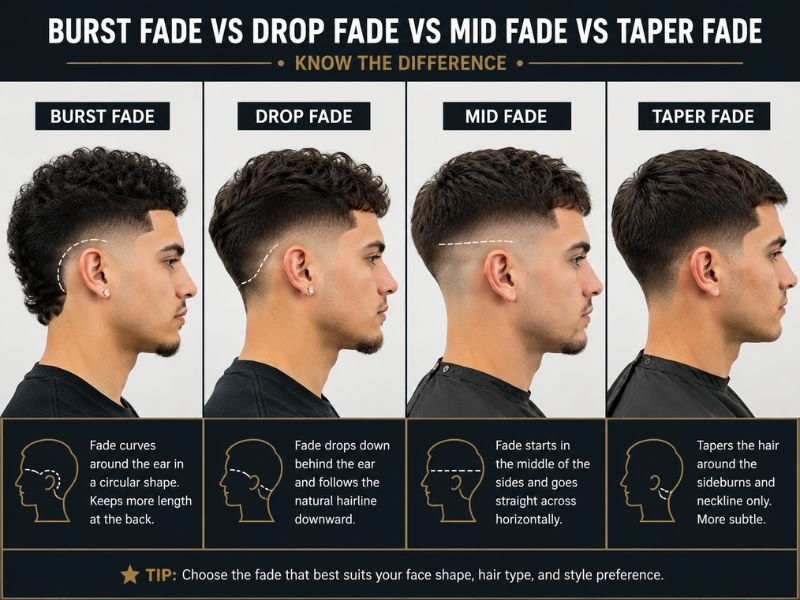
Before committing to a specific look, it is helpful to see exactly how the burst technique stacks up against other popular fading methods. The table below outlines the critical differences in structure, maintenance, and visual impact.Comparing these styles makes it easier to choose the right burst fade haircut for your face shape and lifestyle.
| Fade Type | Fade Line Trajectory | Neckline Coverage | Ideal Hair Textures | Maintenance Level |
| Burst Fade | Rounded semi-circle arcing strictly around the ear | Full coverage; hair at the nape remains long | Curly, Coily, Wavy, Thick | Medium (Every 2–3 weeks) |
| Drop Fade | Drops down behind the ear, lowering toward the back | Partial coverage; tapers low at the nape | Straight, Wavy, Coarse | Medium-High (Every 2 weeks) |
| Traditional Mid Fade | Straight horizontal line across the sides and back | Completely exposed skin or ultra-short hair | All hair types | High (Every 1–2 weeks) |
| Taper Fade | Isolated strictly to the sideburns and the very bottom nape | Completely blended out at the lowest edges | All hair types | Low (Every 3–4 weeks) |
How to Ask Your Barber for a Burst Fade:
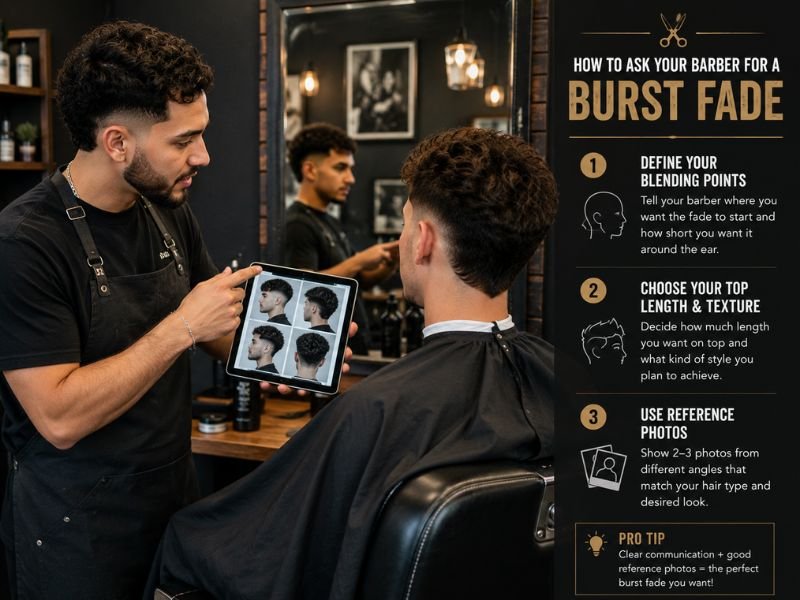
Getting the perfect burst fade haircut starts with clear communication with your barber.Walking into a shop and simply saying “give me a burst fade” can sometimes lead to misunderstandings, as every barber interprets terminology slightly differently. To get the exact look you want, you need to communicate clearly using specific technical terms and visual references.
Step 1: Define Your Blending Points Burst Fade Haircut
Tell your barber exactly where you want the shortest part of the fade to begin and where you want it to end. Specify if you want a true skin fade (0-guard) right around the ear or if you prefer a softer look using a 1 or 2-guard.
Example: “I want a clean barber burst fade that drops down to skin right around my ear, but please keep the hair at the back of my neck long and natural.”
Step 2: Choose Your Top Length and Texture
Explain how you plan to style the top of your hair. If you want a messy texture, request point-cutting or razor work. If you prefer a clean pomp or slick-back, ask them to preserve the length and weight through the upper crown.
Example: “Please leave about three inches of length on top so I can style it with a textured clay, and make sure the transition into the side curve is smooth without any harsh shelves.”
Step 3: Use Reference Photos Wisely
Always bring 2 to 3 photos that show the haircut from different angles (front, side, and back). Make sure the models in your reference photos have a similar hair texture and thickness to your own.
Example: Showing your barber a picture of someone with thick, curly hair when you have fine, straight hair can lead to disappointing results because the two hair types behave completely differently under the clippers.
Step-by-Step Styling Guide for Different Hair Textures:
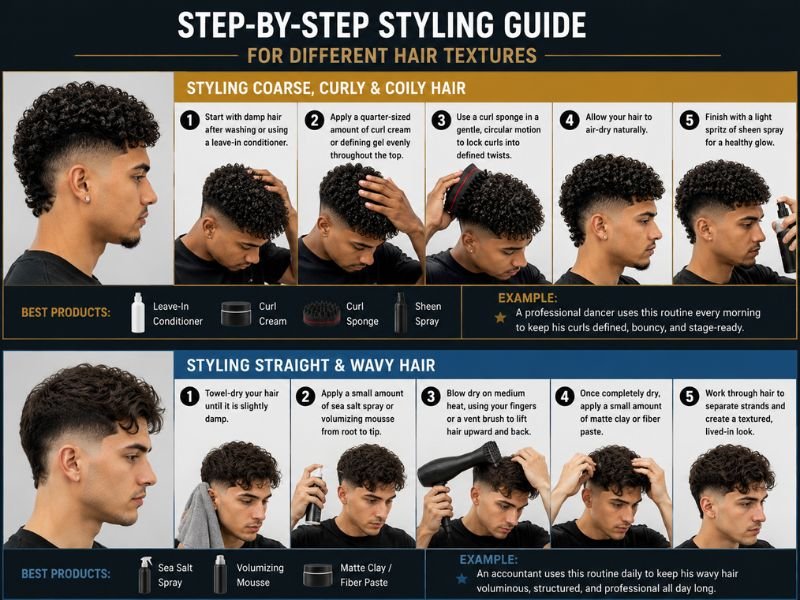
Once you leave the barbershop, maintaining that pristine look depends entirely on your daily styling routine. Because this cut leaves varying lengths across your head, different textures require unique approaches to look their best.
Styling Coarse, Curly, and Coily Hair
For natural curls, the goal is to define the texture on top while keeping the faded sides looking crisp and dry.Styling a burst fade haircut at home only takes a few minutes with the right products.
- Start with damp hair after washing or using a leave-in conditioner.
- Apply a quarter-sized amount of curl cream or defining gel evenly throughout the longer top section.
- Use a curl sponge in a gentle, circular motion across the top of your head to lock your curls into defined twists.
- Allow your hair to air-dry naturally, and finish with a light spritz of sheen spray for a healthy glow.
Example: A professional dancer uses this exact routine every morning to ensure his natural curls stay locked in place and bouncy throughout high-energy routines, keeping his fade looking sharp under stage lights.
Styling Straight and Wavy Hair
For straight or wavy hair, focus on creating volume and texture so the top section doesn’t look flat or limp against the short, faded sides.
- Towel-dry your hair until it is slightly damp.
- Apply a small amount of sea salt spray or volumizing mousse from root to tip.
- Set your blow dryer to medium heat and use your fingers or a vent brush to lift the hair upward and backward, focusing on the front fringe.
- Once completely dry, work a nickel-sized amount of matte clay or fiber paste through your hair to separate the strands and create a textured, lived-in look.
Example: An accountant uses sea salt spray and a matte paste to style his wavy hair every morning, ensuring his hair stays voluminous and structured during long office hours without looking overly greasy or shiny.
Home Maintenance and Upkeep Strategies:
Because the skin-adjacent sections of a burst fade are short, new hair growth shows quickly. To keep your lines clean between barber appointments, implement a simple home maintenance routine.Proper maintenance keeps your burst fade haircut looking fresh between barber visits.
Protecting the Hair Perimeter
When washing your face or showering, avoid using harsh bar soaps on your faded sides, as this can dry out the scalp and cause flaky skin around your ears. Instead, use a gentle moisturizing shampoo and rinse with cool water to keep the skin healthy and irritation-free.
Example: If you notice dry skin or redness around your ears after a fresh cut, applying a drop of alcohol-free tea tree oil or a light facial moisturizer can immediately soothe the area and keep the fade looking clean.
Edging and Line-Ups Between Visits
If you own a reliable pair of home trimmers, you can carefully clean up your neck hairline and sideburns to extend the life of your haircut by a week. However, do not attempt to blend the fade yourself unless you are highly experienced.
Example: Use a handheld mirror to look at the back of your neck, and use your clippers to gently trim away any stray hairs growing below your natural collar line, keeping the focus entirely on the curved arc above.
FAQs:
1. What is a burst fade haircut?
A burst fade haircut features a curved fade around the ears while leaving more length on the top and back for a modern, stylish look.
2. Is a burst fade suitable for all hair types?
Yes, a burst fade works well with straight, wavy, curly, and thick hair when tailored by a skilled barber.
3.How often should you trim a burst fade haircut?
Most burst fades need a touch-up every 2–3 weeks to keep the fade clean and well-defined.
4. What’s the difference between a burst fade and a taper fade?
A burst fade curves around the ear, while a taper fade only shortens the hair around the sideburns and neckline.
5. Which burst fade style is best for a professional look?
A low burst fade is the best choice for a clean, polished appearance that’s suitable for school, work, and formal settings.
Conclusion:
The burst fade haircut is much more than a fleeting trend; it is a highly versatile, artistic approach to modern men’s grooming. By curving the fade line gracefully around the ear while preserving length and volume at the back and top, it offers a balanced silhouette that flatters almost any face shape and hair texture. Whether you choose a bold mohawk variation or a subtle low fade, the key to success lies in understanding your hair type, communicating clearly with your barber, and using the right styling products.