
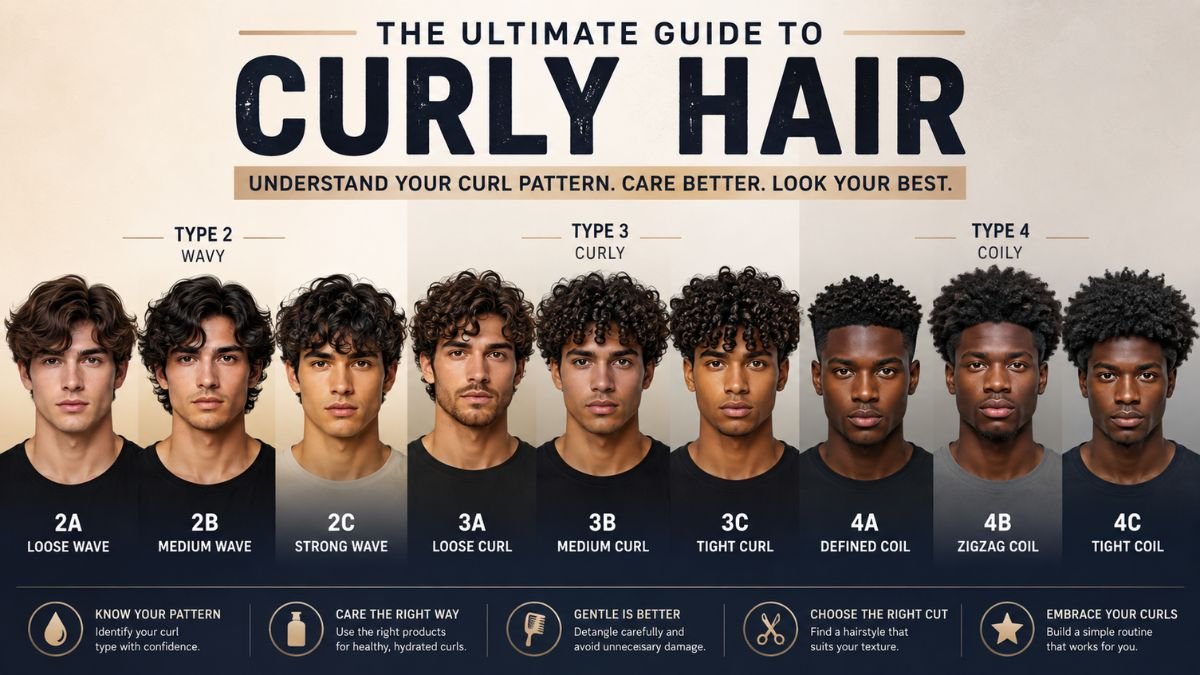
Curly hair can look very different from one person to another. Understanding the different types of curly hair can help you identify your natural curl pattern and learn how to care for it properly. Some men have soft waves, while others have large curls, small spirals, or tight coils. This difference comes from the natural shape of the hair strand. Knowing your pattern can help you understand why your hair behaves the way it does and what kind of care, products, and styling routine it may need.
The types of curly hair are commonly grouped into Type 2, Type 3, and Type 4. These groups cover everything from loose waves to tightly coiled hair. In this guide, you will learn what each pattern looks like, how to recognize your own texture, and how to care for it without making your routine unnecessarily complicated.
Our Practical Tip:
Treat your natural curl pattern instead of trying to change it completely. Start with a small amount of conditioner or styling product, apply it to damp hair, and add more only when needed. This helps maintain natural definition while reducing heaviness and product buildup.
Understanding Curl Patterns:
A curl pattern describes the natural shape that your hair makes as it grows. Hair may bend into a gentle wave, form a spiral, or create a much tighter coil.
The common classification uses numbers and letters. The number represents the broad hair group, while A, B, and C describe how loose or tight the pattern is.
| Curl Type | Pattern | What It Usually Looks Like | Main Need |
| 2A | Loose wave | Soft bends | Light styling |
| 2B | Medium wave | Clear S-shaped waves | Frizz control |
| 2C | Strong wave | Thick waves with some curls | Moisture |
| 3A | Loose curl | Large spirals | Definition |
| 3B | Medium curl | Springy curls | Moisture and hold |
| 3C | Tight curl | Small, dense curls | Hydration |
| 4A | Defined coil | Small coils | Moisture |
| 4B | Zigzag coil | Less rounded bends | Gentle handling |
| 4C | Very tight coil | Dense coils with shrinkage | Consistent hydration |
This system is useful, but it is not a strict rule. A person’s hair can show more than one pattern, and the same types of curly hair can behave differently depending on thickness, length, and density.
Type 2: Wavy Hair
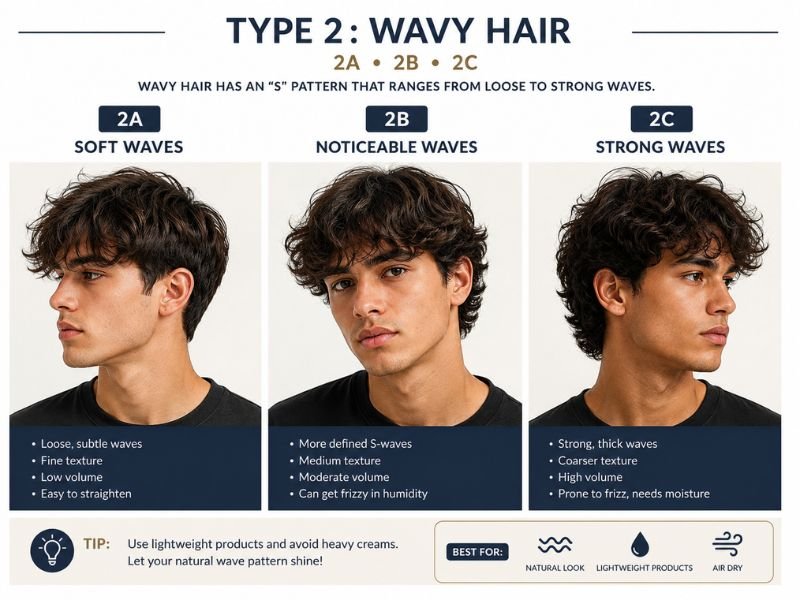
Type 2 hair is often described as wavy rather than fully curly. The strands usually create bends or an S-shaped pattern. The three main forms of types of curly hair are 2A, 2B, and 2C.
2A: Soft Waves
2A is a very relaxed wave. The roots may appear almost straight, while the lower sections develop a gentle bend.
This type usually does not need heavy creams or oils. Too much product can make fine waves look flat.
Example: If your hair looks straight after brushing but develops soft bends when you let it dry naturally, it may be close to 2A.
2B: Noticeable Waves
2B has a stronger wave than 2A. The S-shaped pattern is easier to see, and some people with this texture experience frizz, especially in humid weather. This is one of the common types of curly hair patterns that requires proper moisture and care.
A lightweight styling product can help keep the waves together without making them stiff.
Example: If your hair naturally forms visible waves after washing but rarely creates complete spirals, it may fit the 2B pattern.
2C: Strong Waves
2C sits close to the curly category. The waves are thicker and more pronounced, and some sections may naturally turn into loose curls. This pattern is one of the common types of curly hair that falls between wavy and curly textures.
Because this texture can become dry or frizzy, moisture and gentle styling are often helpful.
Example: If your hair has strong waves with a few loose curls around the ends, 2C may describe your pattern.
Type 3: Curly Hair
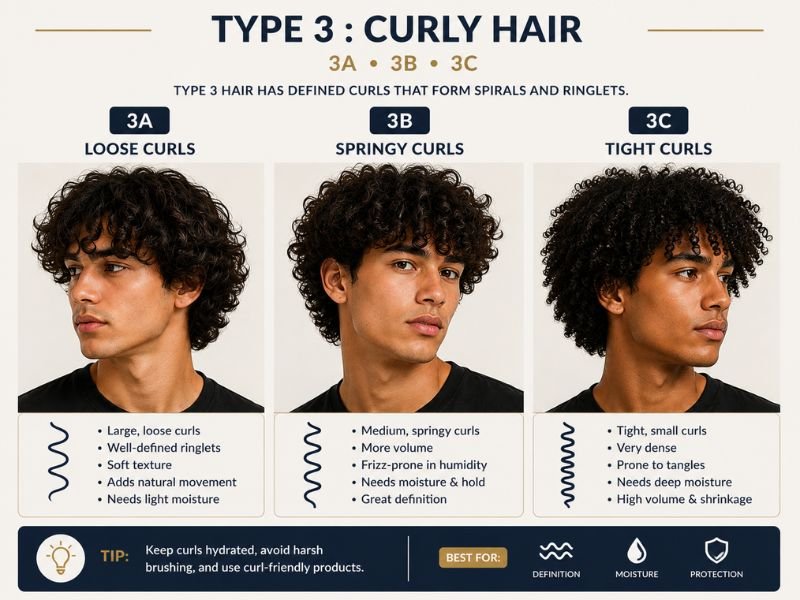
Type 3 hair forms visible curls rather than simple waves. The curls can be large and loose or smaller and more tightly packed.
3A: Large Types of Curly Hair
3A hair usually forms large, relaxed spirals. The curls have noticeable movement and can become more defined when the hair is properly moisturized. This is one of the popular types of curly hair patterns with a soft and flexible curl shape.
Light products are often enough to enhance the curl without making it heavy.
Example: If your hair naturally forms large loops or relaxed spirals, you may have a 3A pattern. Knowing your types of curly hair pattern can help you choose the right care routine.
3B: Springy Types of Curly Hair
3B curls are smaller and tighter than 3A curls. They often have a spring-like shape and can create plenty of volume.
This texture may need more moisture than loose curls, especially when the hair is longer.
Example: If your curls bounce back after being gently stretched and form medium-sized spirals, they may be around 3B.
3C: Tight Types of Curly Hair
3A hair usually forms large, relaxed spirals. The curls have noticeable movement and can become more defined when the hair is properly moisturized. This is one of the popular types of curly hair patterns with a soft and flexible curl shape.
Light products are often enough to enhance the curl without making it heavy.
Example: If your hair naturally forms large loops or relaxed spirals, you may have a 3A pattern. Knowing your curly hair type can help you choose the right care routine.
Type 4: Coily Hair
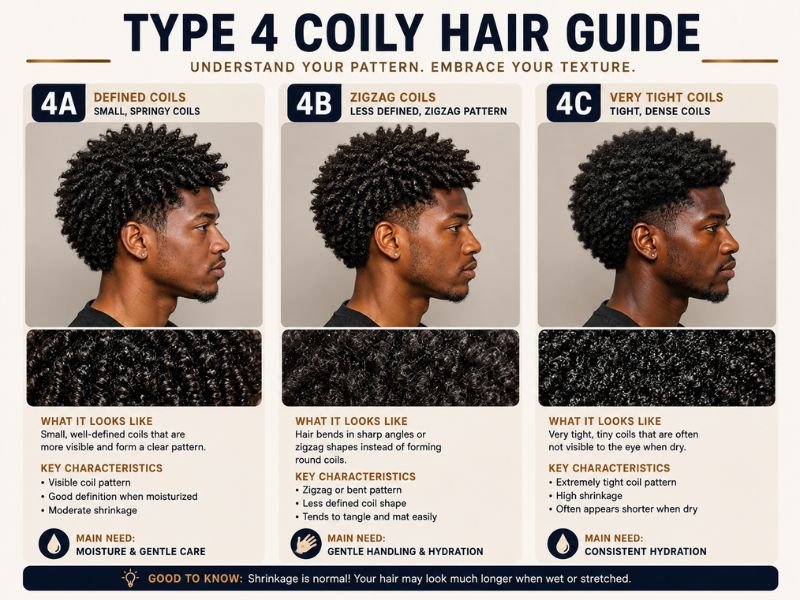
Type 4 hair has a much tighter pattern than Types 2 and 3. It can form small coils or bends and often shows noticeable shrinkage.
Shrinkage means the hair looks considerably shorter in its natural dry state than when it is stretched.
4A: Defined Coils
4A hair usually has small coils that are relatively easy to see. The pattern can look more defined when the hair has enough moisture. This is one of the types of curly hair patterns that needs proper hydration and gentle care.
Gentle care is important because tightly coiled strands can become dry and tangled.
Example: If your hair creates many small, clear coils that spring back after being stretched, it may be close to 4A. Understanding your types of curly hair pattern can help you choose the right products and routine.
4B: Zigzag Pattern
4B hair does not always create round coils. Instead, the strands can bend in a sharper, less circular pattern.
This texture benefits from careful detangling and a routine that helps prevent excessive dryness.
Example: If your strands seem to change direction in small bends instead of forming clear circles, your hair may resemble 4B.
4C: Very Tight Coils
4C has an extremely tight coil pattern. The individual shape may not be obvious when the hair is dry, and shrinkage can be significant. This is one of the types of curly hair patterns that often requires extra moisture and gentle handling.
This does not mean the hair is difficult or unhealthy. It simply means the texture needs a gentle approach and enough moisture.
Example: If your hair appears very dense and much shorter when dry than when stretched, it may be close to 4C. Understanding your types of curly hair pattern can help you create a suitable care routine.
How to Identify Your Curl Type:
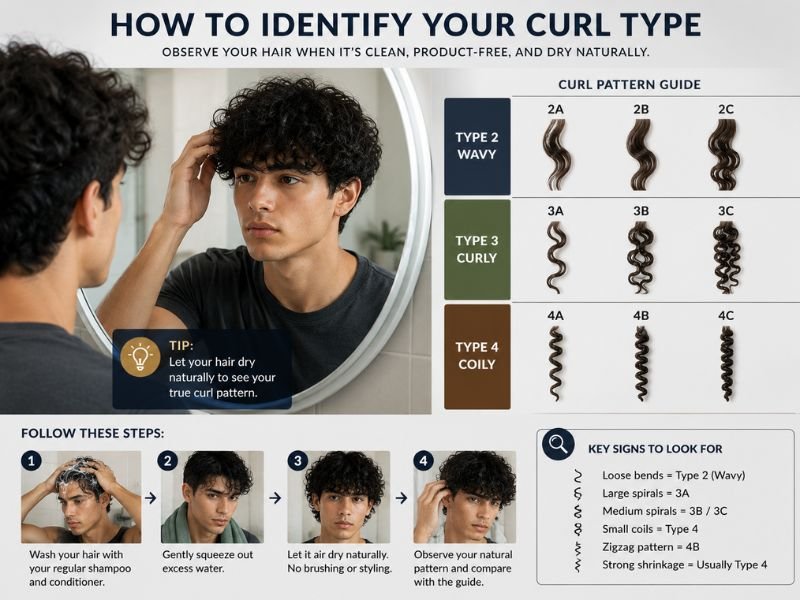
You do not need special equipment to get a general idea of your curl pattern. The easiest approach is to observe your hair when it is clean and free from heavy styling products. Understanding the types of curly hair can help you identify your natural pattern.
Wash your hair using your normal routine and allow it to dry naturally. Avoid straightening or brushing it into a different shape before checking the pattern.
Look for these signs:
- Loose bends: Usually associated with Type 2.
- Large spirals: Often seen in 3A hair.
- Smaller spirals: Common in 3B and 3C.
- Small coils: Often found in Type 4 hair.
- Sharp or less-defined bends: May indicate a 4B pattern.
- Strong shrinkage: Common in tightly coiled hair.
Your entire head does not have to match one category.
Example: The hair around your forehead may form loose curls while the hair at the back may show a different types of curly hair pattern.
Curl Type Is Not the Same as Hair Texture:
One common mistake is thinking that curl type tells you everything about your hair. It does not.
Two men can both have 3A curls but have very different hair. One may have fine strands and low density, while the other may have thick strands and a full head of hair. This shows that even the same types of curly hair pattern can look different depending on hair thickness, density, and texture.
Other factors include:
Hair Thickness
Fine hair may become weighed down by heavy products. Thick hair may need richer conditioning to remain manageable.
Hair Density
Density refers to how much hair you have overall. High-density curly hair can look much fuller than low-density hair with the same curl pattern.
Porosity
Porosity describes how easily your hair takes in and holds moisture. It can affect how your hair responds to conditioners and styling products.
Hair Length
Longer curls often need more care because there is more hair to detangle and moisturize.
This is why choosing products based only on a number such as 3A or 4C may not give you the best result.
How to Care for Curly Hair:
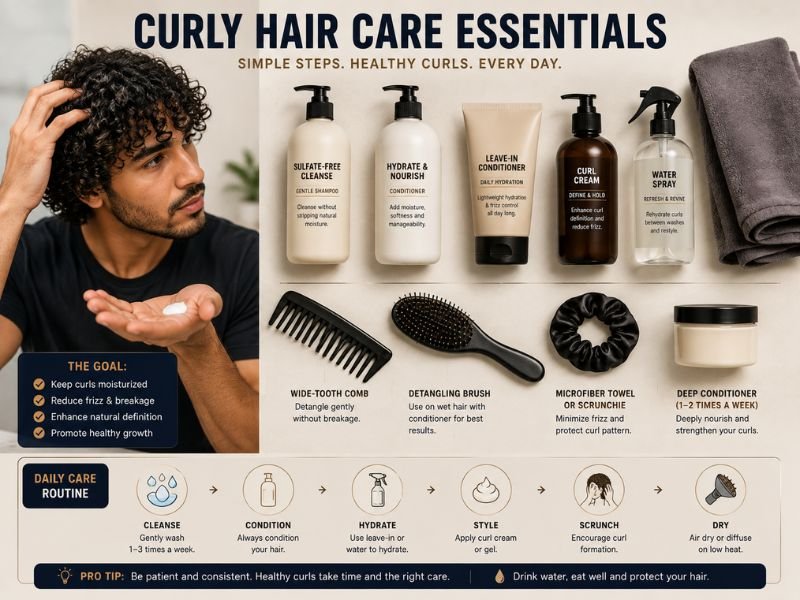
A good routine does not have to contain many products. The most important thing is to treat your natural texture gently.
Use a Suitable Conditioner
Conditioner can help curly and coily hair feel softer and easier to manage. Choose one based on how your hair feels rather than simply buying the heaviest product available.
Detangle Carefully
Pulling a comb through dry, tangled curls can cause unnecessary breakage and disturb the natural pattern.
When possible, detangle damp hair with your fingers or a wide-tooth comb. Work from the ends toward the roots.
Limit High Heat
Frequent high-heat styling can leave hair feeling dry and may change the appearance of natural curls over time.
If you use a dryer, a lower heat setting is usually a gentler choice.
Avoid Product Buildup
Using more product does not always create better curls. Too much cream, gel, wax, or oil can leave hair heavy and difficult to clean.
Start with a small amount and add more only when needed.
Choosing a Haircut for Your Curl Pattern:
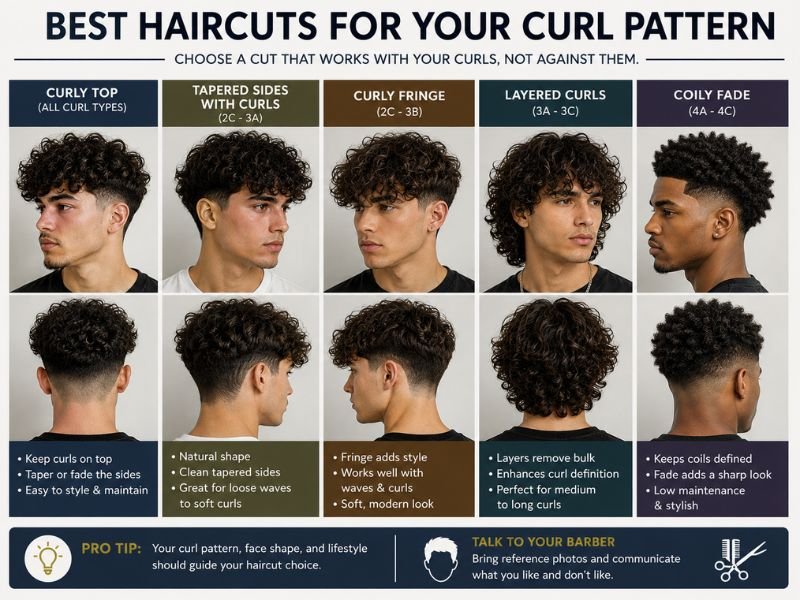
Your haircut should match both your curl pattern and your lifestyle.
Men with wavy hair can consider textured crops, side-swept styles, layered cuts, and medium-length hairstyles.
Men with curly hair have options such as curly tops, tapered sides, curly fringes, layered curls, and medium-length styles.
For coily hair, fades, tapers, short textured cuts, defined coils, and other natural styles can work well.
The best haircut also depends on your face shape and how much time you want to spend styling your hair.
Example: If you want a simple daily routine, keeping the sides shorter and leaving controlled length on top can create a clean shape without requiring extensive styling.
Mistakes to Avoid:
Healthy-looking curls are not only about choosing the right products. Daily habits matter too.
Try to avoid:
- Brushing dry curls aggressively
- Using too much styling product
- Washing with harsh products too often
- Applying high heat regularly
- Ignoring dryness
- Cutting hair without considering shrinkage
- Copying another person’s routine exactly
Your hair may need something different from your friend’s hair, even if both of you have a similar curl pattern.
FAQS:
What are the main types of curly hair?
The main groups are Type 2 wavy hair, Type 3 curly hair, and Type 4 coily hair.
How can I find my curl type?
Wash your hair, let it dry naturally, and observe whether it forms waves, curls, or tight coils.
What is 3A hair?
3A hair has large, loose curls that usually form relaxed spirals.
What is 4C hair?
4C hair has a very tight coil pattern and can show significant shrinkage when dry.
Can one person have different curl types?
Yes. Hair patterns can naturally vary between different areas of the scalp.
How should curly hair be cared for?
Keep it moisturized, detangle gently, avoid excessive heat, and use products that suit your hair’s thickness and needs.
Final Thoughts:
Learning about the different types of curly hair is a useful starting point for better hair care. Type 2 covers waves, Type 3 covers curls, and Type 4 covers tightly coiled patterns. The A, B, and C categories help describe how loose or tight each pattern is.
However, your curl number is only one part of the picture. Hair thickness, density, porosity, length, and moisture levels can change how your curls behave. Once you understand these factors, it becomes much easier to choose a suitable haircut, use the right amount of product, and build a simple routine that works with your natural hair.